
Reviewed · SEINE RIVER CRUISES
Bateaux Mouches Sightseeing Cruise on the Seine River in Paris
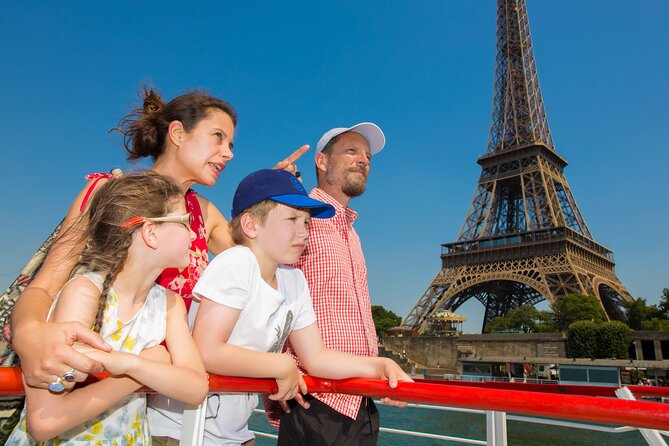
Paris looks best from the river. The Bateaux Mouches cruise gives you a quick, comfortable look at the city’s grandest landmarks, with flexible departures, excellent Eiffel Tower views, and no need to battle traffic. I especially like the 70-minute length and the choice between an indoor deck and open rooftop seating. The main drawback is that commentary can be hard to hear, especially outside or when school groups and loud children are aboard.
At $20.40 per person, this is a fair-value introduction to central Paris rather than a full guided tour. You see a lot in a short time, but you do not stop at any sight, and the boat can become crowded at popular times. I would use it to get your bearings on your first day, then return to the landmarks that deserve a closer look.
In This Review
- Five things to know before boarding
- Why the Seine is a smart way to see Paris
- Port de la Conférence and the flexible boarding system
- Choosing the best seat on the boat
- From Place de la Concorde to the Louvre
- Hôtel de Ville and the medieval heart of Paris
- Notre-Dame and the Île Saint-Louis
- Pont Neuf and the Musée d’Orsay
- Les Invalides, the Eiffel Tower, and Trocadéro
- Commentary, comfort, and onboard extras
- How much value do you get for $20.40?
- The best time to take the cruise
- Who should book this Seine cruise?
- FAQ
- Where does the Bateaux Mouches cruise start?
- How long is the Seine cruise?
- Does the boat make stops along the route?
- Do I need to reserve a specific departure time?
- Is seating reserved?
- Are there toilets on board?
- Can I cancel for a refund?
Five things to know before boarding
- Departures every 30 to 45 minutes: You can board between 10 a.m. and 9 p.m. without choosing a fixed time slot.
- A 70-minute round trip: The boat leaves from Port de la Conférence near Pont de l’Alma and returns there without intermediate stops.
- Two viewing areas: Sit inside in air-conditioned comfort or head to the rooftop for better photographs and open-air views.
- The best Eiffel Tower moments: Sunset and evening departures can show the tower lighting up, but the upper deck can be cold.
- Commentary is not always easy to follow: The advertised language is English, but recorded information may run in several languages and sound quality varies by seating area.
Why the Seine is a smart way to see Paris
The Seine cuts through the historic center, so this cruise puts many major sights in one clean line. From the water, you can see the Louvre, Notre-Dame, the Île de la Cité, the Musée d’Orsay, Les Invalides, the Eiffel Tower, and the Trocadéro museums without crossing a single busy street.
That matters on a first visit. Paris sightseeing often involves long walks, crowded pavements, Metro stairs, and repeated street crossings. On the boat, you sit down and let the city come to you. You also get a useful sense of how the central districts fit together.
I like the cruise best as a first look, not as a replacement for visiting the monuments. The boat gives you attractive views of façades and bridges, but you will not enter the Louvre, climb the Eiffel Tower, or walk through Notre-Dame. Think of it as a moving introduction to Paris.
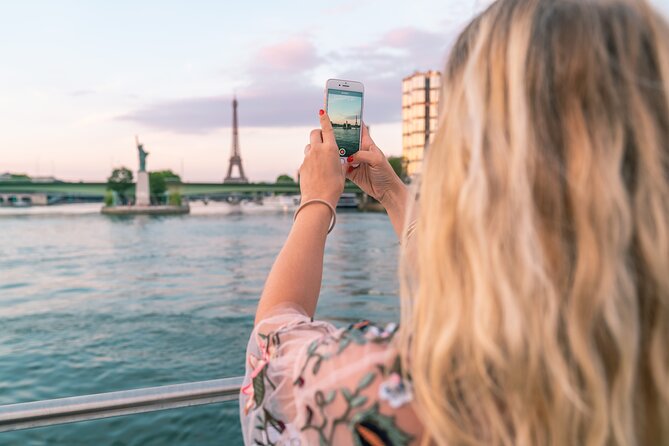
The route stays in the historic heart of the city. It does not go far enough downriver to show the Statue of Liberty, a point worth knowing if that sight is important to you.
More Boat Tours in Paris
- Paris: Evening River Cruise with Music
★ 4.4 · 22,721 reviews - Paris: Louvre Guided Tour with Reserved Access & Boat Cruise
★ 4.3 · 16,353 reviews - Paris: Big Bus Hop-On Hop-Off Tour with Optional Cruise
★ 4.4 · 13,279 reviews
Port de la Conférence and the flexible boarding system
The departure point is Port de la Conférence, 75008 Paris, near Pont de l’Alma. It is close to public transportation, and the cruise ends at the same quay, so you do not have to plan a return journey from a distant dock.
The flexible schedule is one of the strongest features. Boats run daily from 10 a.m. to 9 p.m., with departures generally every 30 to 45 minutes. Your ticket does not require a specific time slot, and the supplied information says it can be used once within two years of purchase, on the date and time you choose.
If you book through a voucher provider, allow time to exchange the voucher for a boat ticket at the ticket desk. Some passengers have boarded quickly, while others have lost time in a second line because they assumed the voucher itself was the boarding ticket.
There is no reserved seating. Arrive early if you care about a rooftop seat, especially around sunset, holidays, or weekends. Boarding can become disorderly when several groups arrive together, and some departures fill before everyone gets the view they want.
Choosing the best seat on the boat
The boats have an inside deck and a rooftop deck. Both give you a view, but they suit different priorities.
The rooftop is best for photographs and a clear look at the bridges and monuments. You can turn from one side to the other more easily, and the open air makes the ride feel more like sightseeing than transport. The cost is exposure to wind, cold, rain, and wet seats after bad weather. December and evening cruises can be particularly chilly, so bring a warm layer even if the weather looks pleasant at the dock.
The inside deck is the safer choice in cold or wet weather. It is air-conditioned and more sheltered, with restrooms available on board. The tradeoff is that windows, reflections, and other passengers can interfere with photographs.
Try to sit where you can see the route information clearly if the narration matters to you. The audio has been described as adequate on some departures and inaudible on others. Outside lower-deck seats may have little or no audible commentary, while passengers inside or on the upper deck may hear more.
This is not a quiet sightseeing experience every time. School groups and excited children can cheer under bridges to hear the echo, and crowd noise can drown out the recording. If learning the history is your main goal, you may find the cruise less satisfying than a dedicated walking tour.
From Place de la Concorde to the Louvre
The cruise route takes in Place de la Concorde, the large royal square designed by architect Ange-Jacques Gabriel in the 18th century. It carries a difficult past: during the French Revolution, a guillotine operated here and thousands of people were executed.
The Egyptian obelisk at the center arrived in 1836, when King Louis-Philippe installed it as a gift from Egypt. From the river, you mainly get the broader setting and the formal Parisian scale of the square. It is a reminder that the city’s grandest spaces often combine royal ambition with revolutionary violence.
The Louvre follows, or appears as part of the central river view. It began as a 13th-century fortress before becoming a royal residence and, in 1793, a museum. Today, its collections include more than 35,000 works, from the Mona Lisa to the Venus de Milo.
The famous glass pyramid, designed by I. M. Pei, has served as the main entrance since 1989. From the Seine, the important point is not the individual artwork but the vast length of the palace beside the river. You see why visiting the Louvre requires a plan and far more time than a single cruise.
More Seine river cruises:
- Paris: Seine Cruise & Crepe Tasting near the Eiffel Tower
★ 4.4 · 11,231 reviews - Paris: Seine River Panoramic Views Dinner Cruise
★ 4.3 · 10,611 reviews - Paris: Eiffel Tower Access by Elevator & Seine River Cruise
★ 4.6 · 7,329 reviews - Paris: 3-Course-Dinner Cruise on the Seine with live music
★ 4.7 · 7,248 reviews
Hôtel de Ville and the medieval heart of Paris
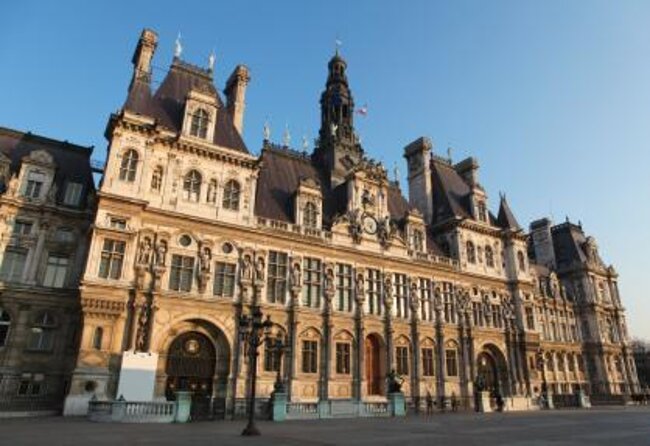
Hôtel de Ville is Paris City Hall, housed in a grand neo-Renaissance building rebuilt in the 19th century after fire destroyed the earlier structure during the Paris Commune of 1871. From the water, its ornate façade adds another layer to the city’s long story of upheaval and rebuilding.
The cruise then brings you close to the older core of Paris, including the Conciergerie. This surviving part of a royal palace later became a prison during the French Revolution. Its river-facing exterior is attractive, but its historical weight comes from what happened inside.
The Île de la Cité is the traditional cradle of Paris. The Parisii, the people who gave the city its name, settled here in the 3rd century BC. Seeing the island from the Seine helps you understand why this small piece of land became the center of the city.
From the boat, you can also appreciate how the riverbanks frame the island. You look up at monuments that are easy to miss when you are walking quickly through nearby streets.
Notre-Dame and the Île Saint-Louis
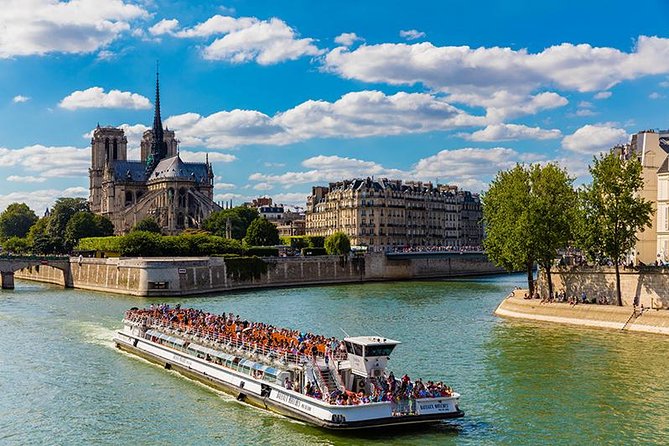
Notre-Dame is the route’s great Gothic centerpiece. Construction began in 1163 and was not completed until 1350. Victor Hugo helped turn the cathedral into a cultural icon through his novel The Hunchback of Notre-Dame, while the 19th-century restoration led by architect Eugène Viollet-le-Duc shaped much of the appearance you recognize today.
The river offers a particularly useful angle on Notre-Dame. You see the cathedral in relation to the island, the bridges, and the surrounding buildings rather than only from the crowded plaza. The view is broad and memorable, though the boat cannot provide the close architectural look you get from standing beside the façade.
The Île Saint-Louis was once called the Île aux Vaches, or Cow Island. Its elegant 16th- and 17th-century houses, many associated with architect Louis Le Vau, line the river with a calmer, more residential character.
This part of the cruise is especially good for photography. The historic façades rise directly from the riverbanks, and the changing light can make the stone appear warm at sunset. Keep in mind that the boat moves steadily, so have your camera ready before the best angle disappears.
Pont Neuf and the Musée d’Orsay
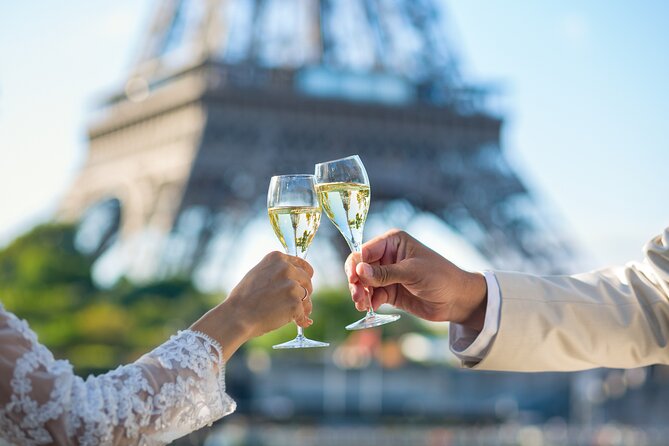
Pont Neuf is the oldest stone bridge in Paris, opened in 1606. In the middle, you can see the equestrian statue of Henri IV, known by the nickname Vert Galant, a reference to his many romantic conquests.
The bridge is a practical landmark as well as a historic one. It connects the Île de la Cité with both sides of the river, and its unusual age makes it easy to pick out from the water. The cruise gives you a lower angle than you get from the pavement, revealing the bridge arches and the statue together.
The Musée d’Orsay occupies a former railway station built for the 1900 World Exhibition. Its grand façade hints at that earlier life, while the museum inside is known for 19th-century art, especially the Impressionist collection.
You will not get a detailed view of the paintings from the boat, of course. What you do see is the handsome station exterior and its position opposite the Louvre. The river makes the relationship between these two major museums clear, which can help you plan a later museum day.
Les Invalides, the Eiffel Tower, and Trocadéro
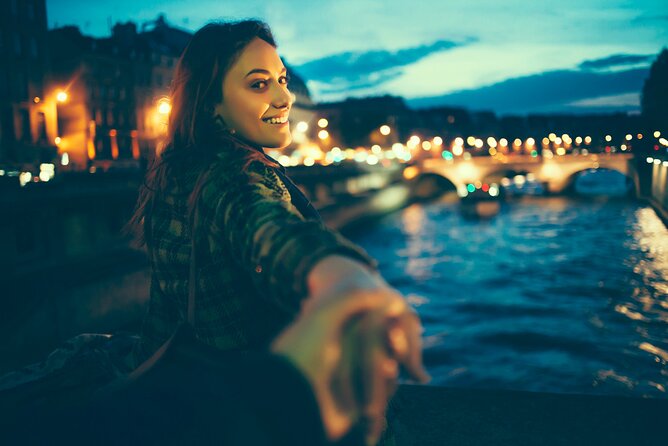
Les Invalides is easy to recognize by its dome covered in gold. Louis XIV originally established the complex as a hospital for wounded soldiers. Today, it houses Napoleon I’s tomb and the Musée de l’Armée.
The golden dome catches the light from the river, particularly late in the day. From the boat, you see the building as part of Paris’s grand ceremonial axis, though the cruise does not stop for an interior visit.
Then comes the Eiffel Tower, the sight most people are waiting for. Engineer Gustave Eiffel designed it for the 1889 World Exhibition. It reaches 324 meters and weighs about 10,000 tonnes, figures that help explain why the structure was such a remarkable feat when built.
The river is one of the best places to frame the tower. You get distance, open sky, and fewer buildings blocking the lower structure. Evening departures can be especially rewarding: the tower may light up during the ride, and a sunset departure lets you watch Paris shift from daylight to night.
Trocadéro appears near the end of the route. Built for the 1937 World Exhibition, it now houses several museums, including the Naval Museum, the Museum of French Monuments, and the Museum of Man.
The cruise gives you a useful look at the monumental arrangement around the Eiffel Tower. It will not replace a visit to the museums, but it shows you how the tower relates to Trocadéro across the river.
Commentary, comfort, and onboard extras
The cruise is offered in English, but the narration may be recorded and presented in four or five languages. That helps explain why the information can feel brief or repetitive. On some departures it is clear enough to follow; on others, outside speakers or crowd noise make it difficult.
I would treat the commentary as a bonus rather than the main reason to book. You can still identify the major sights from the route, and the visual experience remains worthwhile even when the narration fades into background noise.
The boat has restrooms and air conditioning. Seating is free, but it cannot be reserved. Snacks, soft drinks, tea, and coffee are available for an extra charge, with a fast-food outlet on the quay before boarding.
There is no Wi-Fi. Be careful when buying drinks, and check the price shown at the point of sale before paying. One account describes an incorrect charge for bottled water, so a quick glance at the receipt is sensible.
The boat is suitable for all ages. Pushchairs and people with reduced mobility can be accommodated, and service animals are allowed. Small pets must fit in a suitable bag, while larger animals are generally limited to guide dogs. Luggage may be allowed if space permits, but it is not something I would count on during a crowded departure.
How much value do you get for $20.40?
At $20.40, the cruise costs less than many guided sightseeing activities and covers roughly 70 minutes of central Paris views. You are paying for the boat ride, the unusual river perspective, flexible timing, and the chance to rest while seeing a long list of landmarks.
The value is strongest if you are new to Paris, short on time, traveling with children, or dealing with tired legs after a flight. It is also useful on a first evening, when you want a gentle introduction before tackling museums and monuments.
The value drops if you expect a small boat, reserved seating, rich live commentary, or a fully guided history lesson. With a maximum capacity of 1,000 people, this can be a large operation. On a busy day, you might wait 30 to 45 minutes for a boat with space, then find only side seating or standing room.
You also need to remember that the cruise returns to its starting point. It is sightseeing, not river transportation. You cannot get off at Notre-Dame or the Eiffel Tower and continue from there.
The best time to take the cruise
For open seats and a calmer start, the 10 a.m. departure can work well. Early rides may have plenty of room, which makes it easier to choose a rooftop position and move around for photographs.
Sunset is the most atmospheric option. Arrive around an hour before sunset if you want time to exchange a voucher, wait, and find a good position. The city changes color gradually, and the Eiffel Tower may illuminate during the ride.
Night cruises have their own appeal, especially when the tower sparkles. The latest listed departures run until 9 p.m., but check the exact departure schedule on your chosen date. At night, bring warm clothing and expect the line to be popular.
Weather matters more than you might expect. The rooftop is the place to be for views, but cold wind can turn a pleasant cruise into a long shiver. On a rainy day, indoor seating is more practical, though window glare and crowded seats may limit photographs.
Who should book this Seine cruise?
I would recommend it to first-time visitors who want a fast overview, families looking for an easy activity, and anyone who wants a break from walking. The boat is comfortable, the route is attractive, and the flexible boarding policy lets you adjust plans around weather and energy levels.
It is also a good choice for a first few hours in Paris. You can spot the major landmarks from the river, learn how they relate to one another, and decide which ones deserve a return visit on foot.
I would be cautious if you need detailed historical explanation, quiet surroundings, or guaranteed seating. In that case, choose an early departure, sit inside near the audio system, and keep your expectations focused on views rather than instruction.
At this price, I think the cruise is worth booking as a simple orientation ride. Pick a clear evening if possible, arrive early, bring a warm layer, and use the trip to plan the rest of your Paris visit. If you want a personal guide or a stop-by-stop tour, this is not the right product.
FAQ
Where does the Bateaux Mouches cruise start?
The cruise starts at Port de la Conférence, 75008 Paris, near Pont de l’Alma.
How long is the Seine cruise?
The cruise lasts approximately 70 minutes.
Does the boat make stops along the route?
No. The sightseeing cruise leaves from and returns to the same point and does not make intermediate stops.
Do I need to reserve a specific departure time?
No. You can board at a time of your choice during the ticket’s validity period, and departures run every 30 to 45 minutes between 10 a.m. and 9 p.m.
Is seating reserved?
No. Seating is free and cannot be booked in advance.
Are there toilets on board?
Yes. Free restrooms are available on the boats.
Can I cancel for a refund?
Yes. You can cancel at least 24 hours before the experience start time for a full refund. Cancellations or changes made less than 24 hours beforehand are not accepted.
Recently added around Paris
- Private Half-Day Guided Tour of Paris★ 4.5 · 48 reviews
- 2 hour outdoor group activity in Paris: SAINT GERMAIN★ 5.0 · 48 reviews
- Paris Dinner Show Opera Bel Canto★ 4.5 · 48 reviews
- Paris Vintage Tour by Night on a Sidecar with Champagne★ 5.0 · 48 reviews
- Secrets & Scandals of the Louvre – Limited to 6 Guests★ 5.0 · 48 reviews
- Paris Photoshoot: Eiffel Tower Exclusive Private Experience★ 5.0 · 48 reviews
- Paris: Louvre Mona Lisa Discovery Guided Tour with Ticket★ 4.9 · 48 reviews
- From Paris: Versailles Full-Day Guided Tour with Lunch★ 4.9 · 48 reviews
Seine River Cruises, compared.
Paris: Seine Cruise & Crepe Tasting near the Eiffel Tower
Read our review →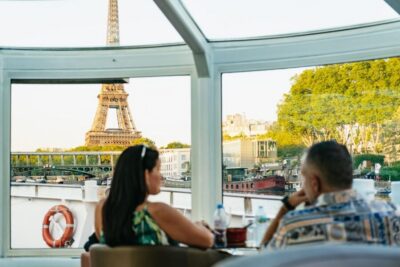
Paris: Seine River Panoramic Views Dinner Cruise
Read our review →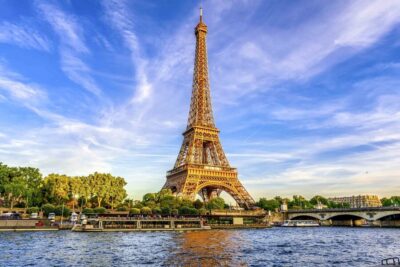
Paris: Eiffel Tower Access by Elevator & Seine River Cruise
Read our review →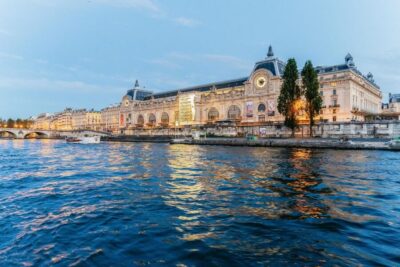
Paris: 3-Course-Dinner Cruise on the Seine with live music
Read our review →
Bateaux Parisiens Seine River Gourmet Dinner & Sightseeing Cruise
Read our review →
Paris: Hop-On Hop-Off Seine Cruise Pass with 9 Stops
Read our review →
Paris : 3-Course Gourmet Dinner Cruise on Seine River
Read our review →Browse the lists this tour appears in