
Reviewed · HISTORICAL TOURS
Le Marais/Paris – The Historic, Trendy, Jewish, LGBT district
Paris rewards slow walking. This tour makes Le Marais especially easy to read, linking Place des Vosges, aristocratic mansions, Jewish landmarks, food shops, and LGBT history in a compact small-group walk. I like its focus on places you could easily pass without noticing, and I like that guides ask about your interests before shaping the route.
The main drawback is that the price, $48.39 per person, is not trivial for a walk lasting about 90 minutes to two hours. Also, one serious scheduling failure was reported, although the overall record is excellent at 4.9 out of 5, with 99 percent of customers recommending it.
In This Review
- Five details that matter before you book
- Why Le Marais works so well on foot
- Starting at Saint-Paul Saint-Louis
- Place des Vosges and Victor Hugo’s Paris
- Narrow streets and the private mansions of Le Marais
- The Jewish quarter, food shops, and wartime memory
- LGBT history and the modern neighborhood
- Food shops, vintage boutiques, and time to wander
- Jill, Eric, and the value of a personal guide
- Is $48.39 a fair price?
- Timing, walking comfort, and practical details
- Who should book this Le Marais walk?
- Should you book it?
- FAQ
- Where does the Le Marais tour begin?
- Where does the tour end?
- How long does the walking tour last?
- What language is the tour offered in?
- How much does the experience cost?
- What is included in the price?
- Are snacks, coffee, or tea included?
- How many people can join the tour?
- Can I cancel for a full refund?
Five details that matter before you book
- Place des Vosges begins the story: See one of Paris’s most elegant squares and learn about Victor Hugo’s former home.
- The route favors details over famous monuments: Expect narrow streets, grand private mansions, courtyards, gardens, galleries, and small shops.
- Jewish and LGBT history are central themes: This is more than a general stroll through pretty streets.
- Guides tailor the walk: Jill is praised for lively explanations and personal attention, while Eric has adapted routes for families and Jewish-history interests.
- A group of 10 maximum keeps it personal: That makes questions and route changes easier than on a large city tour.
- Bring comfortable shoes and your own snack: Food and drinks are not included, and the walk takes place outdoors.
Why Le Marais works so well on foot
Le Marais is one of the best Paris districts for connecting architecture with everyday life. The streets are narrow, the buildings change from grand aristocratic residences to small shops, and the neighborhood carries several identities at once.
You get the former royal district, the Jewish quarter, the LGBT district, art galleries, vintage boutiques, artisan food shops, and historic courtyards. A good guide helps you see these layers without reducing the area to a collection of photo stops.
I especially like the tour’s emphasis on urban mansions. In Paris, an hôtel particulier is a private city residence built for an affluent family, usually with a street-facing entrance and spaces arranged behind it. You may walk past these buildings without realizing what they were, or how much they reveal about French society.
The walk also links local places to larger events. The guide can connect Le Marais with the monarchy, revolutions, the creation of the French Republic, World War II, Jewish immigration, and present-day LGBT life. That wider context gives the neighborhood more meaning than a simple architecture tour.
More Historical Tours in Paris
- Paris: Dark History and Ghostly Guided Walking Tour
★ 4.7 · 1,000 reviews - Paris City of Fashion History Private Guided Walking Tour
★ 5.0 · 221 reviews - History of Paris City Center w/ Notre Dame Semi-Private 12ppl Max
★ 5.0 · 194 reviews
Starting at Saint-Paul Saint-Louis
The meeting point is Paroisse Saint-Paul Saint-Louis, at 99 Rue Saint-Antoine. This gives you a clear starting point on the edge of Le Marais, near public transportation and within easy reach of central Paris.
The first part of the experience is likely to feel more historical than commercial. You are not being rushed toward a famous museum or a major ticketed attraction. Instead, the guide begins by placing the district in its Paris setting and then walks you into the streets where the main themes unfold.
The tour is offered in English. Jill is the guide most frequently praised in the feedback, and her style seems particularly suited to people who enjoy questions, stories, and conversation rather than a memorized speech. She is described as energetic, warm, and attentive to individual interests.
Eric has also led the walk. His route has been adjusted for a family of seven that wanted extra time in the Jewish area, and he has been praised for explaining French kings, revolutions, and the growth of the Republic in a way that connects directly to the streets around you.
Place des Vosges and Victor Hugo’s Paris
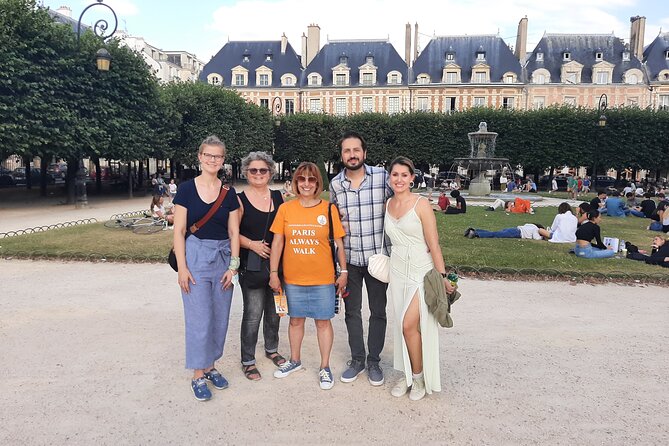
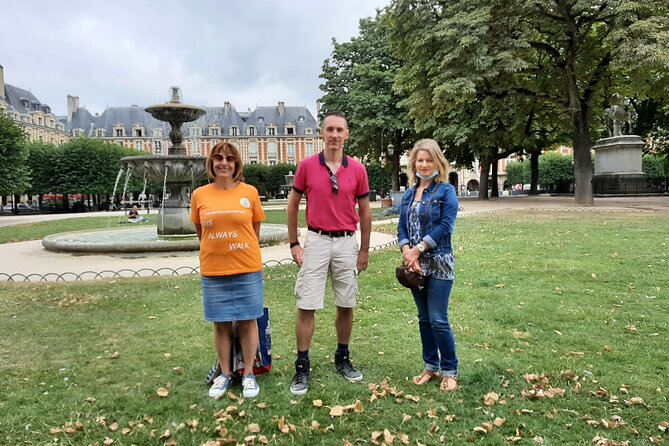
Place des Vosges is the first named stop, with about 20 minutes set aside for it. Formerly called Place Royale, this square is known for its consistent architecture and arcaded edges, which create a calm, enclosed feeling in the middle of the city.
You will have time to look at the square, hear why it mattered to the monarchy, and see the art galleries around it. The stop is free, so the value comes from the guide’s explanation rather than from an admission ticket.
Victor Hugo’s connection gives the square a literary angle. The French writer lived here and wrote the romantic novel Notre-Dame de Paris. The tour uses that connection to show how Le Marais has attracted writers, artists, aristocrats, and political figures over the centuries.
I would not expect a long literary lecture or an interior museum visit from this stop. The strength is the setting itself and the way a guide can point out details you might otherwise miss. If Victor Hugo’s residence is a major priority, ask the guide exactly what you will see and whether the route includes an interior visit, since the supplied details only confirm the residence as a landmark.
Narrow streets and the private mansions of Le Marais
The next section lasts about 15 minutes and focuses on the architecture of French aristocracy and royalty. You walk narrow streets lined with former hôtels particuliers, the grand private residences that helped define the district.
This is a short part of the walk, but it may be the most useful for anyone interested in buildings. One architectural review praised the guide’s attention to structures, plazas, and streets, and that is where a personal guide can earn the fee.
Look up as you walk. Doorways, façades, courtyards, and the relationship between public street space and private residence all tell part of the story. A guide can explain why a building looks grand from the street, where its original residents lived, and how the district changed over time.
The walk does not appear to include admission to a mansion or museum during this portion. That keeps the pace simple, but it also means you should book this for interpretation and street-level discovery, not for a series of interior visits.
For me, this section would suit repeat visitors to Paris particularly well. You get a new way to look at familiar city architecture, and the guide can adjust the emphasis if you care more about design, politics, religion, or social history.
A completely different sort of day in Paris:
- Paris: Louvre Museum Timed-Entrance Ticket
★ 4.6 · 71,977 reviews - Disneyland® Paris 1-Day Ticket
★ 4.6 · 49,412 reviews - Paris: Versailles Palace and Gardens Full Access Ticket
★ 4.6 · 41,579 reviews - Paris: Evening River Cruise with Music
★ 4.4 · 22,721 reviews
The Jewish quarter, food shops, and wartime memory
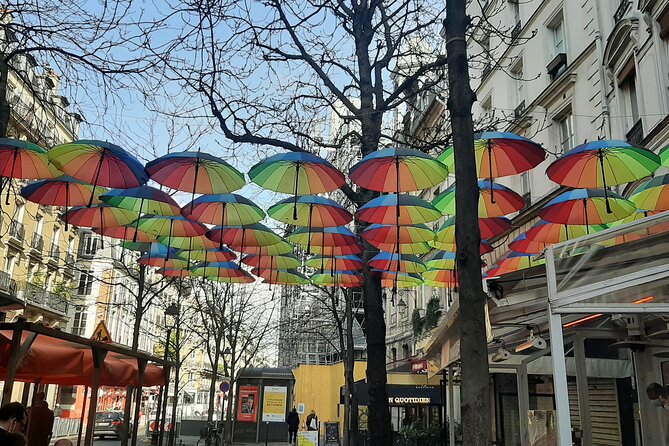
About 20 minutes are devoted to the Jewish quarter. The route goes beyond the main streets toward less touristy courtyards and gardens, then points out typical food stores and kosher pastries.
This section gives the tour a more personal and contemporary feel. Food shops show that the district is not only a historic setting. It remains a place where cultural identity is visible in daily life.
The guide also connects the area to Jewish immigration and World War II. Those subjects require care, and the strongest feedback describes the guide as sincere, thorough, and able to explain the connection between Le Marais and major events in French history.
The allotted 20 minutes is enough for an introduction, but it is not a full study of Jewish Paris. If this is your main reason for booking, tell the guide at the start. The route has been adapted for people who wanted more attention on Jewish history, so your interests may influence how the time is used.
You should also understand that snacks are not included. The tour may point you toward food shops and pastries, but you pay separately for anything you buy. That is actually a plus for many people, since you can choose what interests you rather than receive a standard tasting that may not suit your diet or appetite.
LGBT history and the modern neighborhood
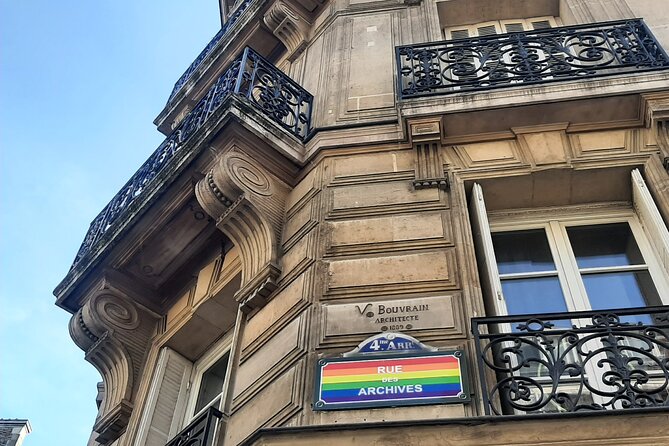
The tour title includes the LGBT district, and several guide descriptions specifically mention LGBT history alongside Jewish history. This is important because Le Marais is not presented only as an old royal quarter or a shopping district.
The route appears to treat the neighborhood as a place shaped by many communities. You may learn how older buildings and streets now function within a modern LGBT center, while also seeing how different histories overlap in the same blocks.
The available information does not promise a fixed list of LGBT venues or a dedicated museum visit. You should think of this as a guided look at the district’s cultural and social identity, combined with architecture and local history.
That flexible approach may work best for you if you want context rather than a narrowly themed tour. It also explains why asking about your interests matters. A family may want a broad introduction, while another group may want more time on Jewish or LGBT history.
Food shops, vintage boutiques, and time to wander
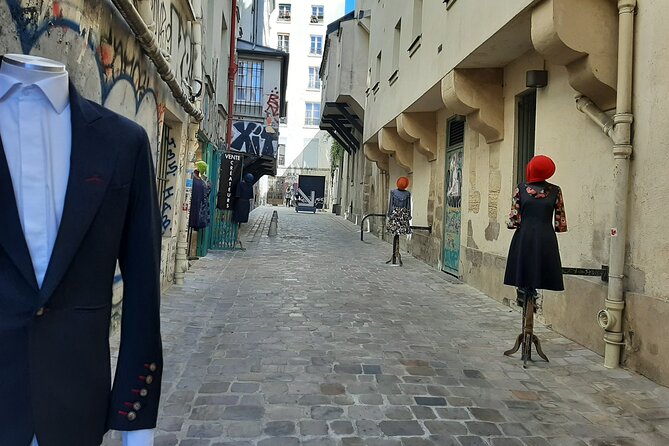
Le Marais is well suited to browsing after the formal walk ends. The route includes artisan food shops, vintage boutiques, galleries, pastries, and other local businesses.
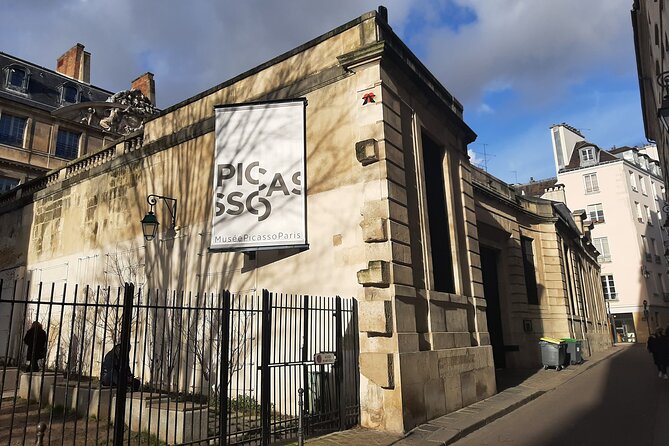
The official end point is Musée des Archives Nationales, Hôtel de Soubise, at 60 Rue des Francs Bourgeois. That is a useful place to finish because you are left in the middle of the district rather than returned to the starting church.
I would save extra time after the tour. The walk itself lasts roughly 90 minutes to two hours, but the area deserves a slower second look. You can use the guide’s suggestions to decide where to eat, shop, or continue exploring.
One useful feature is the way a private or very small group can change the experience. Several accounts describe guides spending extra time with a small group or even continuing for an additional hour. Do not assume that extra time is guaranteed, but it shows the value of speaking up if a particular courtyard, food tradition, or historical subject catches your attention.
Jill, Eric, and the value of a personal guide
Jill receives the strongest praise. Her approach is described as lively, humorous, generous, and highly responsive to questions. She has also been praised for engaging a 10-year-old, bringing Christmas cookies on a cold walk, and continuing to explain the district even in rain.
Those details suggest a guide who treats the walk as a conversation. That matters in Le Marais because the best details are not always obvious. You may need to ask why a courtyard matters, how a building was used, or how a neighborhood changed.
Eric has also made a strong impression. He has adapted a route for a family group and for people especially interested in the Jewish quarter. His explanations connect local sights with French kings, revolutions, and the Republic.
The overall rating is 4.9 from 341 reviews, and 99 percent recommend the experience. One one-star account reports that a guide did not appear because of a technical problem that prevented the booking from being canceled. The tour did not take place in that case, so the complaint is about a serious service failure rather than the quality of the walk itself. It is worth confirming your meeting details before setting out.
Is $48.39 a fair price?
At $48.39 per person, this is not the cheapest way to see Le Marais. You can walk through the district without paying anything, and the named stops themselves do not require admission tickets.
The question is what you want from your time. If you are happy to look at façades, squares, and shops on your own, save the money. If you want a clear explanation of the monarchy, aristocratic architecture, Jewish history, LGBT culture, and local neighborhoods in one walk, the fee is more reasonable.
The group limit of 10 improves the value. A small group gives you a better chance to hear clearly, ask questions, and request a slight change in emphasis. A large bus-style tour could not offer the same personal response.
The tour also saves research time. You do not have to identify every private mansion, work out which streets belong to the Jewish quarter, or connect Place des Vosges with Victor Hugo on your own. For a first day in Le Marais, that orientation can help you make better use of the rest of your visit.
Timing, walking comfort, and practical details
Plan for 90 minutes to two hours, with the possibility that a very small group may receive extra attention. The route is outdoors and involves walking through streets, squares, and courtyards, so comfortable shoes are sensible.
The experience is offered in English and includes a guide. Snacks, coffee, and tea are not included. You can buy food separately at shops along or near the route, but do not count on a formal tasting.
The meeting and ending points are different. Start at Saint-Paul Saint-Louis and finish at the National Archives, Hôtel de Soubise. Both locations are near public transportation, and the activity is suitable for most people. Service animals are allowed.
Free cancellation is available if you cancel at least 24 hours before the local start time. Cancellations or changes made inside that window are not accepted for a refund.
Who should book this Le Marais walk?
I would choose this tour if you want a first introduction to Le Marais with real historical context. It suits couples, families, solo visitors, architecture fans, and anyone who wants more than a quick stroll between cafés and shops.
It is particularly useful if Jewish or LGBT history matters to you, since those subjects are part of the route rather than an afterthought. Tell the guide your priorities at the beginning so the flexible format works in your favor.
Families may also like the personal approach. One account specifically praises Jill for involving a 10-year-old, while Eric has guided a family group with two teenagers. Still, keep in mind that the tour is built around history and walking, so younger children who need constant activity may find parts of it slow.
I would skip it if you want major museum interiors, a food tasting included in the fee, or a fast list of famous Paris sights. This is a street-level neighborhood walk, and its value depends on your interest in stories, buildings, communities, and small details.
Should you book it?
Yes, if you want a thoughtful introduction to Le Marais and appreciate a guide who can adjust the route to your interests. The strongest reasons to book are the small group, the Jewish and LGBT focus, the architecture of the private mansions, and the praised guiding style of Jill and Eric.
At $48.39, the walk is best treated as a paid orientation to one of Paris’s most layered districts. Leave time afterward for food shops, boutiques, galleries, and further wandering. Confirm the meeting details before departure, then let the guide know what you most want to understand.
FAQ
Where does the Le Marais tour begin?
The tour begins at Paroisse Saint-Paul Saint-Louis, 99 Rue Saint-Antoine, 75004 Paris, France.
Where does the tour end?
The tour ends at Musée des Archives Nationales, Hôtel de Soubise, 60 Rue des Francs Bourgeois, 75003 Paris, France.
How long does the walking tour last?
The stated duration is approximately one hour and 30 minutes to two hours.
What language is the tour offered in?
The tour is offered in English.
How much does the experience cost?
The listed price is $48.39 per person.
What is included in the price?
A tour guide is included.
Are snacks, coffee, or tea included?
No. Snacks, coffee, and tea are not included.
How many people can join the tour?
The maximum group size is 10 people.
Can I cancel for a full refund?
Yes. You can cancel at least 24 hours before the experience start time for a full refund. Changes or cancellations made less than 24 hours before the start time are not accepted for a refund.
Recently added around Paris
- Private Half-Day Guided Tour of Paris★ 4.5 · 48 reviews
- 2 hour outdoor group activity in Paris: SAINT GERMAIN★ 5.0 · 48 reviews
- Paris Dinner Show Opera Bel Canto★ 4.5 · 48 reviews
- Paris Vintage Tour by Night on a Sidecar with Champagne★ 5.0 · 48 reviews
- Secrets & Scandals of the Louvre – Limited to 6 Guests★ 5.0 · 48 reviews
- Paris Photoshoot: Eiffel Tower Exclusive Private Experience★ 5.0 · 48 reviews
- Paris: Louvre Mona Lisa Discovery Guided Tour with Ticket★ 4.9 · 48 reviews
- From Paris: Versailles Full-Day Guided Tour with Lunch★ 4.9 · 48 reviews
Historical Tours, compared.
Paris: Louvre Museum Entry with History of Mona Lisa
Read our review →
Paris: Dark History and Ghostly Guided Walking Tour
Read our review →
Vieux Lyon Cultural & Historical Walking Guided Tour (English)
Read our review →
Bordeaux: Historic Center & Chartrons District Bike Tour
Read our review →
From Strasbourg: Best Of Alsace Historical Day Trip
Read our review →
Toulouse Food & History Tour with a Chef (in English)
Read our review →
Small-Group Full-Day Tour of Côte de Nuits, Côte de Beaune Vineyards and Beaune Historical District
Read our review →
Browse the lists this tour appears in