
Reviewed · HISTORICAL TOURS
Historic Bayeux Daily Group City Tour In English 2 hrs (Apr-Sept)
Bayeux rewards a closer look. This two-hour walk takes you beyond the obvious sights, linking medieval streets, the River Aure, the cathedral, Roman remains, and the town’s role in the 1944 liberation. I like the small-group format, limited to 20 people, and the guide’s use of old photographs to make vanished streets and past events easier to picture. I also like the price: at $24.20, you get a useful introduction without spending half a day indoors.
The main catch is that this is an outdoor walking tour with many standing stops. You will not enter the museums or cathedral, and the English-only format requires a good command of the language. Still, for a first morning in Bayeux, it offers a smart way to get oriented and decide what deserves a longer visit.
In This Review
- Key points before you book
- Why two hours is a good length in Bayeux
- Starting beside the tourist office
- Rue des Teinturiers and the River Aure
- Allée des Augustines and the famous medieval embroidery
- The Liberty Tree and the French Revolution
- Notre-Dame Cathedral from the outside
- Roman Bayeux on Rue Léonard Lambert Leforestier
- Place Charles de Gaulle and liberation in 1944
- What the guides do especially well
- Who will get the most from this walk?
- How to use the tour with the rest of your day
- Is this Bayeux walking tour worth booking?
- FAQ
- Where does the Bayeux walking tour start?
- What time does the tour begin?
- Where does the tour finish?
- How long does the tour last?
- Is the tour conducted in English?
- Does the tour include the Bayeux museums?
- Does the tour go inside Bayeux Cathedral?
- How many people can join the group?
- What should I wear?
- Can I cancel for a refund?
Key points before you book
- More than 20 stops in two hours: Expect a brisk but manageable route through Bayeux’s medieval center and less obvious corners.
- Strong local storytelling: Guides such as Christele, Christine, and Marie-Noëlle are praised for clear explanations, humor, and memorable anecdotes.
- History beyond the famous embroidery: The route covers Celtic origins, Roman Bayeux, medieval trades, the Norman conquest, the French Revolution, and liberation in 1944.
- Useful visual aid: A binder filled with old photographs helps you compare modern Bayeux with earlier versions of the town.
- No indoor admissions: You see the cathedral and museum exteriors, but entrance tickets and interior visits are not part of the tour.
- Plan for the practical details: Wear comfortable shoes, use the restroom beforehand, and bring an umbrella or weatherproof layer.
Why two hours is a good length in Bayeux
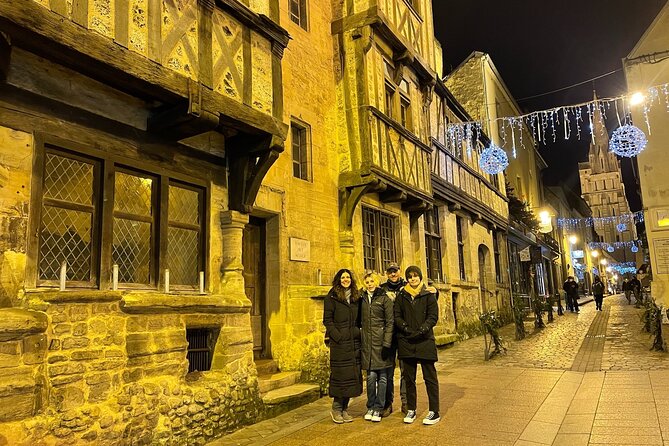
Bayeux is compact, but its story is not. A short walk can take you from Roman foundations to medieval commerce, then forward to the French Revolution and the Allied liberation. Without a guide, it is easy to admire the stone buildings while missing the clues that explain why they look the way they do.
This tour gives you that framework in a focused morning. The 9:30 a.m. start works especially well if you are staying in town or arriving early. You finish near the center, close to the cathedral and several museums, so you can continue exploring while the information is still fresh.
The route includes more than 20 stops, although only the major points are listed for planning purposes. That means you should expect frequent pauses rather than one long march. The walking itself is described as easy, but standing can become tiring, especially for anyone with back trouble or during pregnancy. A foldable stool is recommended, and public benches are used when available.
At $24.20 per person, I consider the price fair for a two-hour English-language tour with a maximum of 20 participants. You are paying for local interpretation, not admission tickets. If you were planning to visit the cathedral and museums anyway, you should think of this as an orientation walk rather than a replacement for those visits.
More Historical Tours in Bayeux:
- Paris: Louvre Museum Entry with History of Mona Lisa
★ 3.9 · 2,823 reviews - Paris: Dark History and Ghostly Guided Walking Tour
★ 4.7 · 1,000 reviews - Vieux Lyon Cultural & Historical Walking Guided Tour (English)
★ 5.0 · 942 reviews
Starting beside the tourist office
The meeting point is at 3 Rue Saint-Jean, at the Bayeux tourist office area. Confirmation arrives at booking, and the walk begins at 9:30 a.m. Arrive ready to start on time, since a city walk with many stops is difficult to join midway.
The opening minutes set up Bayeux through language, local customs, architecture, famous figures, and past events. The guide’s commentary is designed to be cheerful as well as informative, which matters here. A long list of dates can make any old town feel like homework. Anecdotes and everyday expressions give the history a more human scale.
The guides receive especially strong praise for delivery. Christele is described as an enthusiastic storyteller with a good sense of humor. Marie-Noëlle brings the perspective of someone who has lived in Bayeux for 35 years, while Christine is praised for explaining the town clearly and making the time pass quickly.
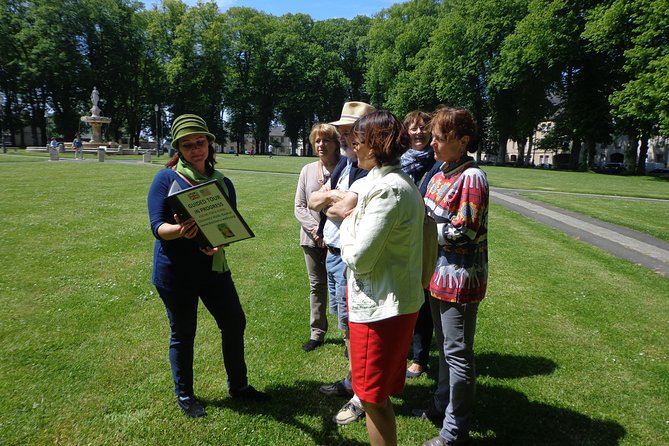
The guide may use a large binder of historical photographs during the walk. This is one of the most useful features because old images can show how streets, buildings, and wartime scenes changed. You are not just hearing that Bayeux looked different. You get a visual aid to help place the past against the present town.
Rue des Teinturiers and the River Aure
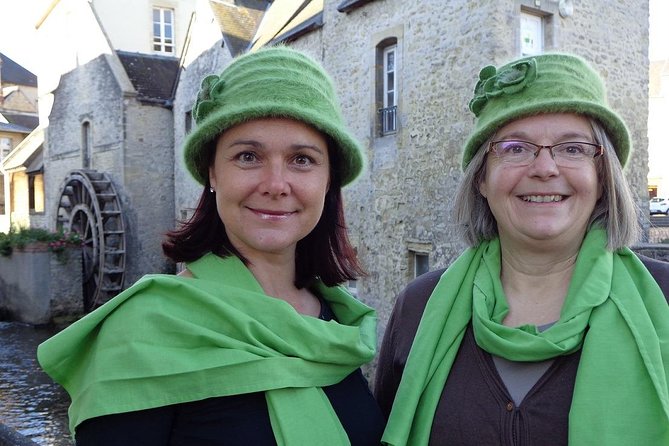
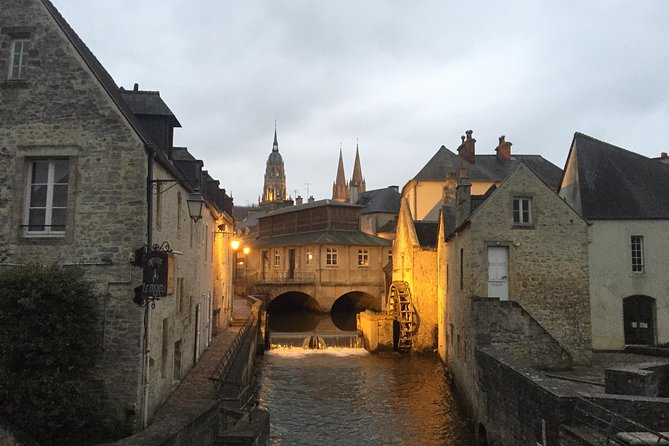
The stop on Rue des Teinturiers introduces the working side of medieval Bayeux. The focus is on trades such as tanning and dyeing, along with the role of the River Aure in supporting them.
This is the kind of detail you can easily miss on a self-guided stroll. A beautiful street may look purely decorative now, but the river helped power the town’s industry and daily life. The discussion connects water, craft, commerce, and the physical shape of the town.
You should expect about ten minutes here. It is a short stop, but it helps you read Bayeux as a place where people worked, not simply as a collection of old façades. The route also includes architectural details that reveal the relative ages of buildings, giving you a better eye for what you are seeing later in the walk.
Allée des Augustines and the famous medieval embroidery
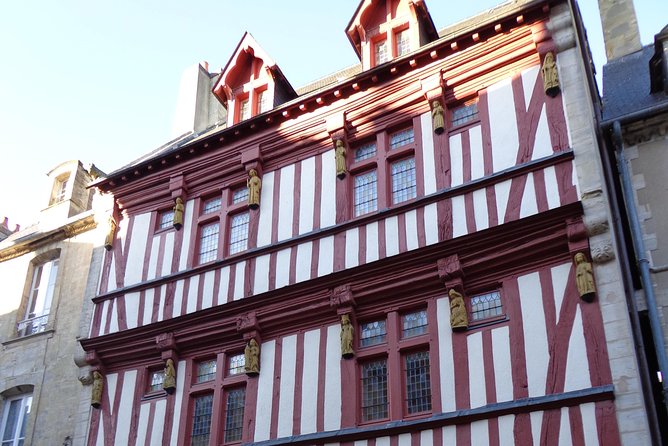
The longest pause comes at Allée des Augustines, with about 25 minutes devoted to several connected subjects. You learn about the Augustinian sisters and their effect on the Bayeux community. One sister also left her mark in the country now known as Canada, adding a wider human connection to what might otherwise seem like a local religious story.
The guide also stops outside the museum devoted to Bayeux’s famous 11th-century embroidery. The museum is closed until October 2027, so this explanation is particularly useful if your visit falls during that closure. You will not see the work inside, but you will receive context about the Battle of Hastings, William the Conqueror’s accession to the English throne, and the people and events shown in the embroidery.
The discussion covers its historical importance, how it was made, and additional facts and figures. This is not a substitute for viewing the original, but it can make a later museum visit more rewarding once the museum reopens. If you are visiting before October 2027, check current plans separately and do not expect the walking tour to provide museum entry.
This stop may be the most important one for anyone coming to Bayeux mainly for Norman history. It connects the town to England without treating the famous embroidery as an isolated object. You get the political background and the local setting around it.
A few more Bayeux trips worth weighing up
- Normandy American D-Day Beaches Full Day Tour from Bayeux
★ 5.0 · 2,103 reviews - Normandy American D-Day Experience – Group tour from Bayeux
★ 5.0 · 1,566 reviews - Normandy Beaches Half-Day Afternoon Trip from Bayeux (A2)
★ 4.5 · 1,116 reviews - Omaha and Band Of Brothers Full Day Tour
★ 5.0 · 1,104 reviews
The Liberty Tree and the French Revolution
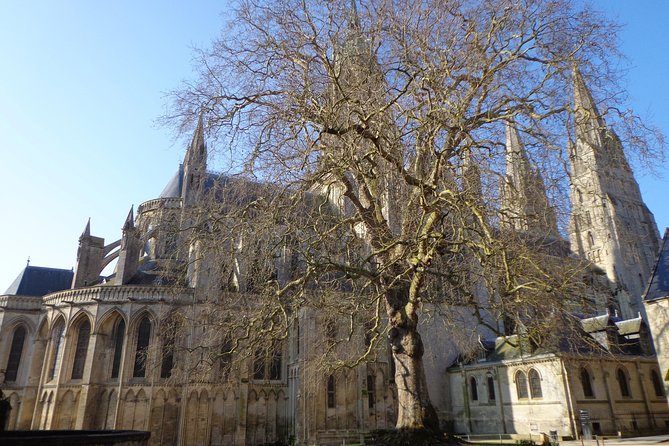
At the Arbre de la Liberté, the guide explains why the more-than-200-year-old sycamore is known as the Liberty Tree. The stop links a living tree to the French Revolution, giving you a simple, memorable way to understand how revolutionary ideas were marked in public spaces.
The tree is also a useful change of pace. Instead of looking only at stonework, you are considering a surviving symbol that has remained in place for generations. The explanation is scheduled for about ten minutes, so expect a concise account rather than a full lecture on the Revolution.
This is the sort of stop that makes a town walk feel local. You are not simply moving from one grand monument to another. You are learning why an ordinary-looking feature matters to Bayeux.
Notre-Dame Cathedral from the outside
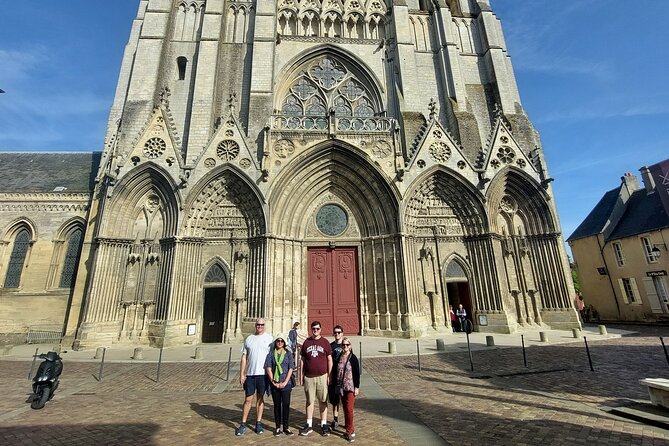
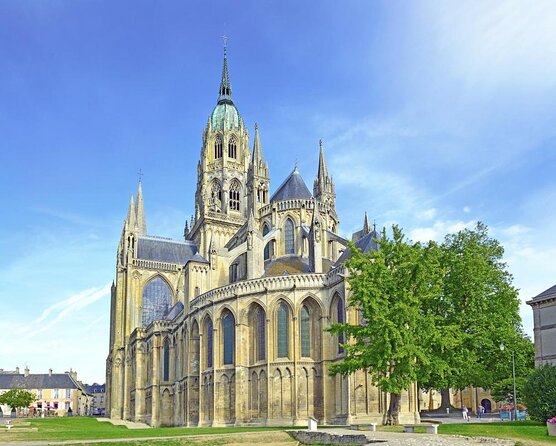
The cathedral stop lasts around 20 minutes and focuses on the different stages of construction and the building’s architectural features. You can expect help reading the exterior, especially the way a major church can reveal changes made over time.
The tour does not include entry into Notre-Dame Cathedral. That limitation is important. If you want to study the interior, you will need to return on your own, subject to opening arrangements. The walking tour gives you context and viewing time outside, but it does not provide an indoor visit.
For many people, this is still valuable. Large churches can be hard to understand when you only take a quick photograph and move on. A guide can point out features and explain how the building developed, helping you notice more when you return independently.
Because this is a standing stop, anyone with limited stamina should keep the practical advice in mind. Bring a small foldable stool if needed, and do not assume the cathedral itself will offer a break during the tour.
Roman Bayeux on Rue Léonard Lambert Leforestier
The walk then reaches Rue Léonard Lambert Leforestier, where the guide traces Bayeux’s origins back to Celtic times and points out the remains of the Roman castrum.
This stop broadens the story before the medieval material takes over. Bayeux did not begin with William the Conqueror, and its oldest layers help explain why the town became important in the first place. Roman ruins are often easy to overlook when they are not presented as a large, separate archaeological site. Here, the guide gives them a place in the town’s wider story.
The scheduled time is about 15 minutes. You are likely to hear more about origins and urban development than see a large ruin complex, so keep expectations realistic. The value comes from connecting fragments in the modern street plan with the earlier settlement.
Place Charles de Gaulle and liberation in 1944
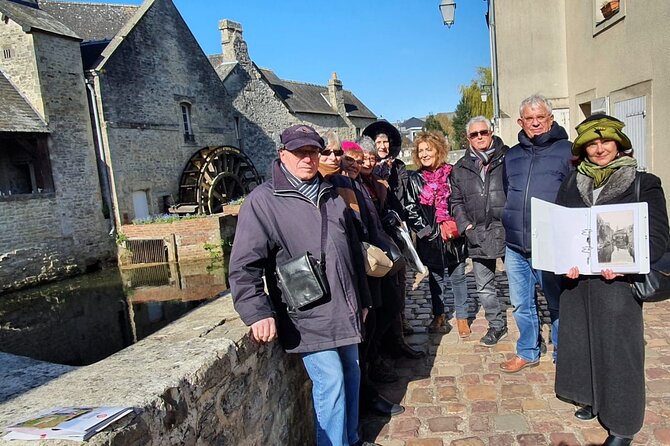
The final major stop is Place Charles de Gaulle, where the guide recounts Bayeux’s liberation on June 7 and General de Gaulle’s first visit to the square.
This gives the tour a modern historical endpoint. Bayeux is often visited as a medieval town or as a base for D-Day excursions, but the two subjects are not separate. The town’s wartime experience is part of its identity, and the square provides a place to discuss the immediate aftermath of liberation.
The account is scheduled for about 15 minutes. It should help you understand Bayeux’s role in the Second World War without turning the whole tour into a battlefield excursion. If your main goal is a detailed D-Day tour, this walk will not replace one. If you want Bayeux itself placed within the liberation story, it is a useful addition.
What the guides do especially well
The strongest part of this experience is the human delivery. The guides are repeatedly praised for being friendly, funny, clear, and well prepared. Christele, Christine, and Marie-Noëlle are named in the feedback, and each is described as bringing history to life through anecdotes rather than reciting a dry script.
That style suits Bayeux. The town’s story crosses languages, countries, religions, wars, trades, and centuries. A good guide needs to move between those subjects without losing you. The comments about clear English are important because the tour does not allow simultaneous translation, and recording the guide is not permitted.
The historical photographs also add real value. One binder of images can do more than a string of dates, particularly when the guide is explaining lost buildings, old streets, or wartime change. I would pay attention to those comparisons and make mental notes of places you may want to revisit.
The group limit of 20 is another practical plus. It is not a private tour, but it is small enough for a guide to keep the group together and answer occasional questions. The actual feel can vary depending on the day’s attendance, and the tour may be especially personal if numbers are low.
Who will get the most from this walk?
I would choose this tour if you are new to Bayeux and want a clear first look before visiting museums or booking a Normandy excursion. It is also a good fit if you like architecture, local customs, and stories about ordinary work alongside major political events.
You will get the most from it if you understand spoken English well. The tour is exclusively in English, and translation during the commentary is not allowed. If you need frequent interpretation, this is not the right format.
The walk suits most people who can manage two hours on foot with repeated standing. Comfortable shoes are essential. Bring an umbrella because weather can change, and plan your restroom stop before meeting the group. There are no scheduled bathroom breaks.
This is less suitable if you need a seated tour, want extensive indoor access, or prefer a private guide who can adjust the pace throughout. No luggage storage is available at the tourist office, and only backpacks can be brought on the walk. Service animals are allowed, and the meeting point is near public transportation.
How to use the tour with the rest of your day
The best strategy is to take the walk early in your Bayeux stay. The route ends at Au Comptoir des Saveurs, 45 Rue Saint-Martin, in the heart of town. From there, you are near the cathedral and museums covering the famous embroidery, art and history, and lace.
Use the guide’s explanations to choose what deserves a second look. You might return to the cathedral exterior with a better sense of its construction, visit the museums when open, or explore a shop or restaurant that caught your attention during the walk.
The route can also improve a Normandy itinerary. After learning how Bayeux fits into Norman and wartime history, you will have a stronger base for visits beyond the town. The walk itself does not include museums, battlefield sites, or transport to other locations, so plan those separately.
The tour operates seasonally, listed for March through September, with the experience title specifying April through September. Confirm that your chosen date is available, especially near the edges of the season. Free cancellation is available until 24 hours before the local start time, which gives you some flexibility if weather or plans change.
Is this Bayeux walking tour worth booking?
Yes, I would book it for a first morning in Bayeux, especially at $24.20. The price is reasonable for two hours of focused local guidance, and the mix of medieval industry, Roman remains, cathedral architecture, Revolution symbolism, Norman politics, and 1944 liberation is broader than a simple monument walk.
Book it if you value stories, visual aids, and local details that are easy to miss alone. Skip it if you mainly want museum entry, an indoor cathedral tour, or a detailed D-Day excursion. For most visitors who want to understand Bayeux before exploring it on their own, this is a practical and enjoyable starting point.
FAQ
Where does the Bayeux walking tour start?
The tour starts at 3 Rue Saint-Jean, 14400 Bayeux, France, at the Bayeux tourist office area.
What time does the tour begin?
The stated start time is 9:30 a.m.
Where does the tour finish?
The walk ends at Au Comptoir des Saveurs, 45 Rue Saint-Martin, in central Bayeux.
How long does the tour last?
The walking tour lasts approximately two hours.
Is the tour conducted in English?
Yes. It is an English-only group tour, and participants should have a good level of English.
Does the tour include the Bayeux museums?
No. Museum admission is not included, and the tour does not enter the museums.
Does the tour go inside Bayeux Cathedral?
No. The cathedral is visited from the outside, with commentary about its construction and architecture.
How many people can join the group?
The tour has a maximum group size of 20 participants.
What should I wear?
Wear comfortable shoes and clothing suitable for a walking tour. An umbrella is also recommended.
Can I cancel for a refund?
You can cancel at least 24 hours before the local start time for a full refund. Cancellations or changes made less than 24 hours before the start are not accepted for a refund.
Recently added around Bayeux
- From Bayeux: Half-Day Normandy WWII Sidecar Tour★ 5.0 · 49 reviews
- Private Tour of American Sites with an Expert Guide from DDAY★ 5.0 · 51 reviews
- WW2 Jeep or Dodge truck tour of the Omaha Beach site★ 5.0 · 51 reviews
- Mont Saint Michel Full Day Tour from Bayeux★ 5.0 · 52 reviews
- Bayeux: Band Of Brothers Full-Day Tour★ 4.9 · 53 reviews
- From Bayeux: D-Day American Beaches and US Airborne Day Tour★ 4.8 · 56 reviews
- From Bayeux: 2-hour private sidecar tour in Normandy★ 5.0 · 58 reviews
- Normandy – Mont Saint-Michel Full Day Tour from Bayeux★ 4.5 · 62 reviews
Historical Tours, compared.

Paris: Louvre Museum Entry with History of Mona Lisa
Read our review →
Paris: Dark History and Ghostly Guided Walking Tour
Read our review →
Vieux Lyon Cultural & Historical Walking Guided Tour (English)
Read our review →
Bordeaux: Historic Center & Chartrons District Bike Tour
Read our review →
From Strasbourg: Best Of Alsace Historical Day Trip
Read our review →
Toulouse Food & History Tour with a Chef (in English)
Read our review →
Small-Group Full-Day Tour of Côte de Nuits, Côte de Beaune Vineyards and Beaune Historical District
Read our review →
Browse the lists this tour appears in