

Reviewed · MUSEUMS
Les Invalides: Napoleon’s Tomb & Army Museum Entry
History lives large here. Les Invalides combines Napoleon’s ornate tomb, royal armor, world-war exhibits, and one of Paris’s grandest buildings in a single ticket. You can wander at your own pace through collections covering the Middle Ages to the present, with more than 500,000 objects on display.
I especially like the gilded Dome Church and the museum’s sheer range. You can see medieval weapons, French royal armor, cannons, uniforms, paintings, photographs, and personal belongings without joining a fixed tour. The main drawback is simple: this is far bigger than many first-time visitors expect, so a rushed two-hour visit will leave a lot unseen.
In This Review
- Key points to know before you go
- Why Les Invalides is more than Napoleon’s Tomb
- The Dome Church and Napoleon’s enormous final statement
- The armor and weapons collection from kings to soldiers
- Napoleon, empire, and the making of a legend
- World War I and World War II: the part that needs real time
- The Museum of Plans-Reliefs and other included collections
- How long should you allow?
- Entry times, entrances, and practical details
- Is the $20 admission good value?
- Who will enjoy Les Invalides most?
- Should you book Les Invalides?
- FAQ
- How much does admission to Les Invalides cost?
- How long is the ticket valid?
- What does the ticket include?
- Is a guided tour included?
- Can I buy a multimedia guide?
- When can I enter from the Esplanade des Invalides?
- When can I enter from Place Vauban?
- Do I need to keep my ticket after entering?
- Do children enter for free?
- Is Les Invalides wheelchair accessible?
Key points to know before you go

- Napoleon’s Tomb sits beneath the gilded Dome, an ornate church that has served as his resting place since 1861.
- The Army Museum covers centuries of warfare, from medieval armor and royal weapons to World War I, World War II, and the French Resistance.
- Your ticket is valid for one day, allowing you to leave for lunch and return during opening hours.
- The site includes several museums, including the Museum of Plans-Reliefs and the Museum of the Order of the Liberation.
- A multimedia guide costs €5 extra, while a guided tour is not included.
- Keep your ticket handy, since you may need to show or scan it again when entering different parts of the complex.
Why Les Invalides is more than Napoleon’s Tomb
Many people arrive expecting a quick look at Napoleon’s sarcophagus, a few photographs, and perhaps a short walk through a military gallery. That plan underestimates the place.
The Hotel National des Invalides was created by Louis XIV to house veterans and wounded soldiers. Today, its buildings hold the Musée de l’Armée, the Dome Church, and several related collections. The result feels less like one ordinary museum and more like a group of connected historical worlds.
You can begin with the architecture, then move through arms and armor, Napoleonic campaigns, the two world wars, and the French Resistance. The subjects are linked, but each section has a different mood. Some rooms feel ceremonial and royal. Others are more personal, using photographs, uniforms, films, and belongings to show how war affected ordinary people.
I like this mix because you are not asked to view French military history from only one angle. You see the pageantry of kings, the ambitions of emperors, the mechanics of battle, and the human cost of modern conflict.
More Museum Tours in Paris:
- Paris: Louvre Museum Timed-Entrance Ticket
★ 4.6 · 71,977 reviews - Louvre Museum Masterpieces Guided Tour with Access
★ 4.5 · 12,023 reviews - Paris: Louvre Museum Entry Ticket With Host and River Cruise
★ 4.6 · 9,926 reviews
The Dome Church and Napoleon’s enormous final statement
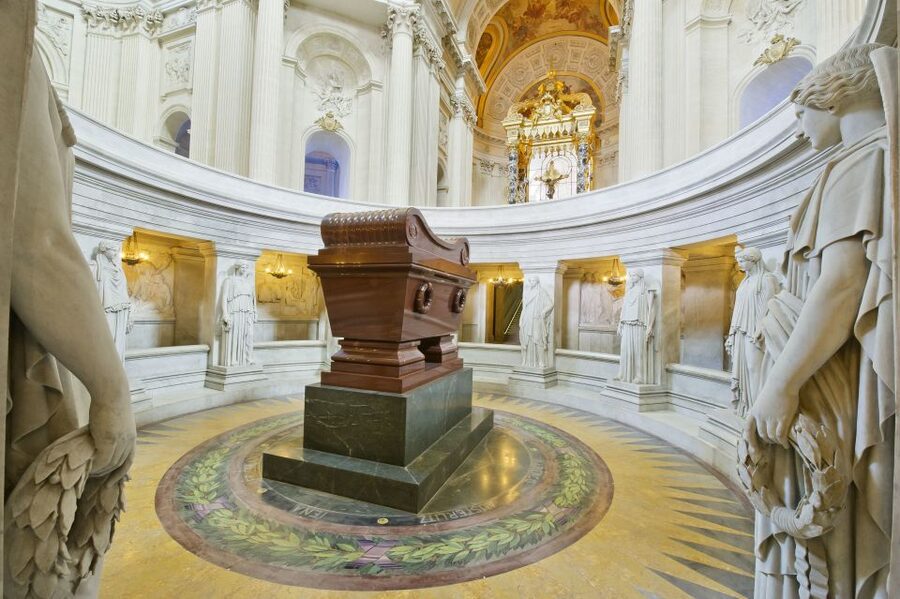
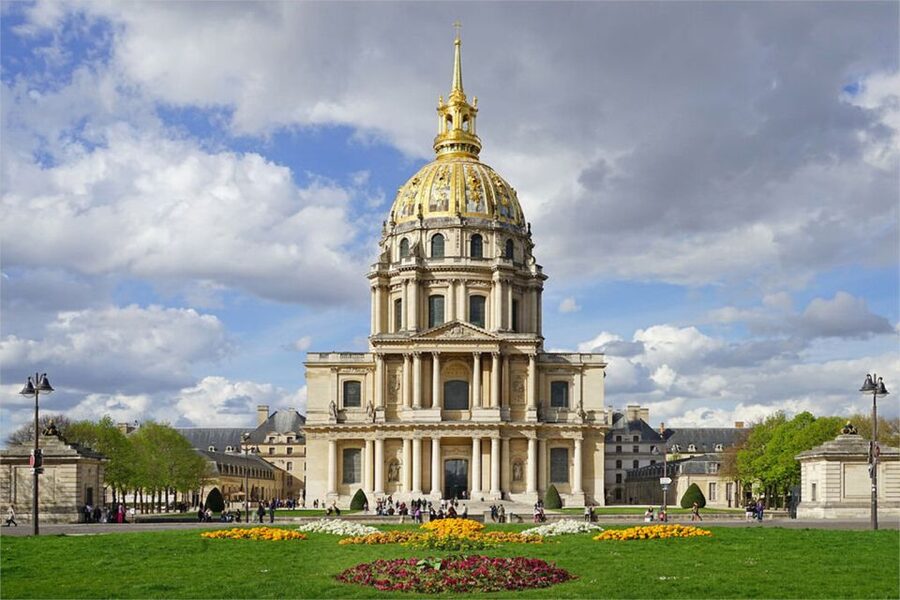
The Dome is the emotional center of the visit. Its golden exterior is one of the most recognizable sights in Paris, and the inside is just as dramatic. Under the soaring dome, Napoleon’s tomb occupies the center of the church floor, surrounded by decorative elements and crypt spaces.
The tomb is made from red porphyry and placed on a green granite base. Even if you know little about Napoleonic history, the setting makes the political message clear. This was not designed as a modest burial. It presents Napoleon as a figure worthy of a monumental national shrine.
You can look down toward the tomb from the surrounding level and see it from several angles. The interior architecture deserves time of its own, so do not treat the Dome as a passageway between museum rooms. The richly decorated surfaces, grand proportions, and careful layout are a major reason many people consider this their favorite part of Les Invalides.
The crypts and nearby memorial spaces add another layer. You will see how France chose to remember its military leaders and national figures. That does not mean you have to admire Napoleon. The setting can be beautiful while the man himself remains open to debate, and the museum gives you room to make that judgment.
The armor and weapons collection from kings to soldiers
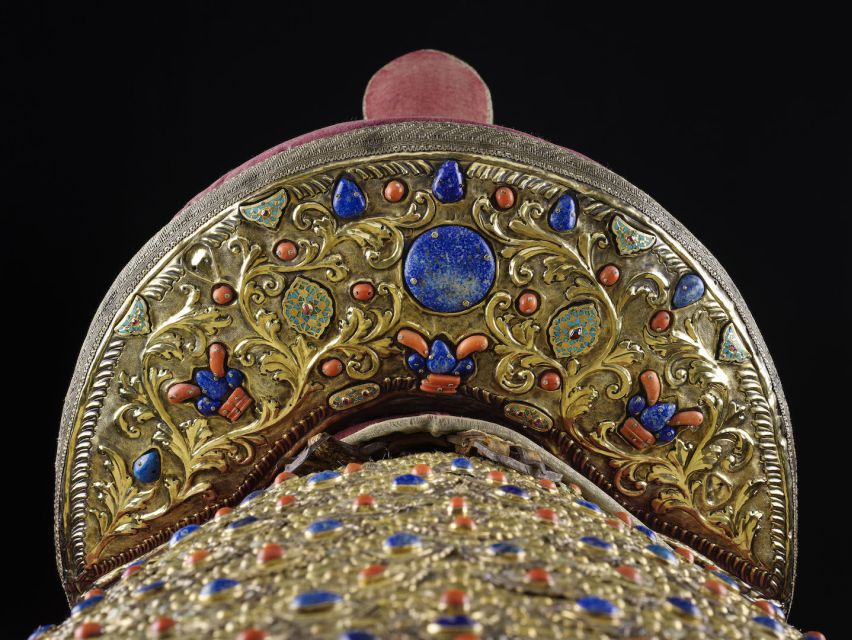
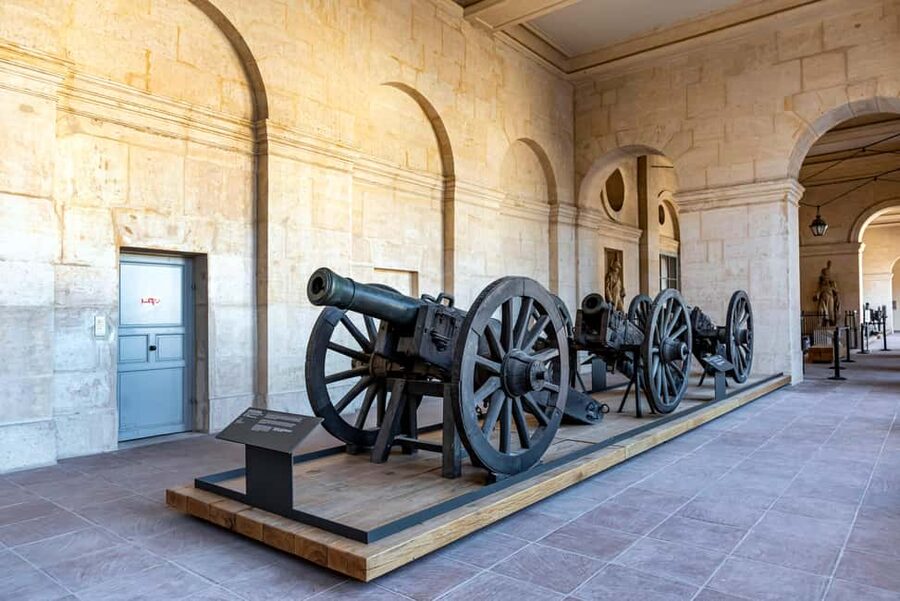
The Army Museum’s oldest sections are a treat for anyone interested in medieval Europe, royal France, or the practical side of warfare. Here you can see armor, swords, firearms, cannons, and other weapons arranged across long stretches of French military history.
The armor is not merely decorative. It helps you picture warfare before modern guns and mass armies changed the battlefield. Details in helmets, shields, breastplates, and ceremonial pieces show the difference between equipment made for combat and armor designed to display status.
The collection also connects military objects with royal power. Weapons and armor belonging to or associated with French kings help explain how warfare, ceremony, and monarchy overlapped. You are looking at objects that were used, displayed, inherited, and sometimes turned into symbols.
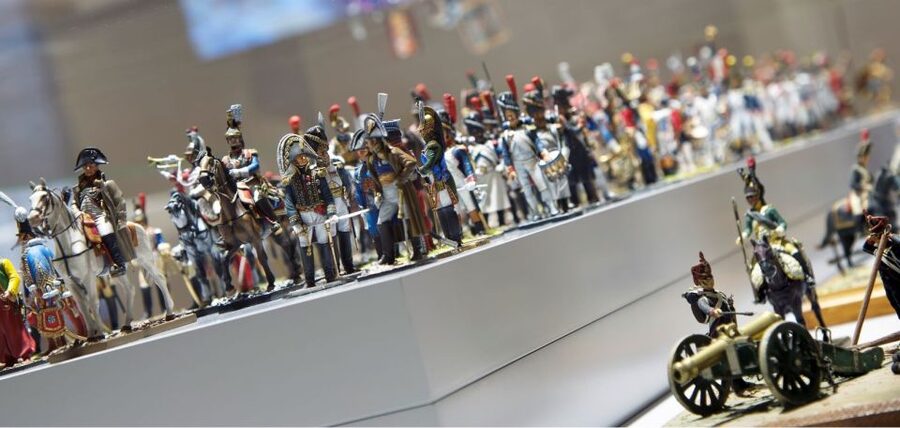
This section suits families well. Children often respond faster to armor and weapons than to written political history, and the scale models and visual displays add variety. The museum also provides seating throughout, useful when you are visiting with children or simply need a break from Paris pavement.
Napoleon, empire, and the making of a legend
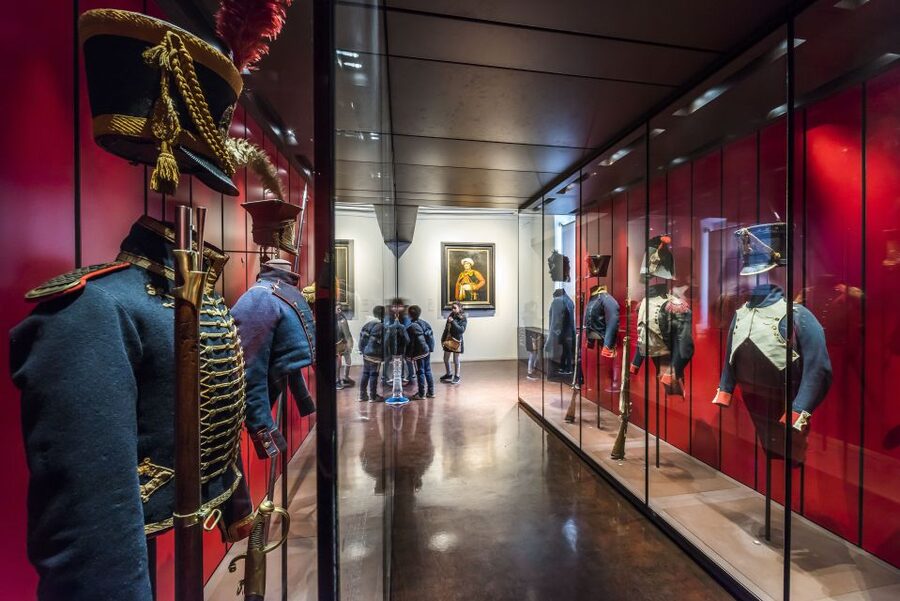
The Napoleonic sections help place the famous tomb in context. You can follow the military world around Napoleon through uniforms, weapons, paintings, personal belongings, and objects connected with France’s major figures.
The museum does not reduce everything to a simple hero story. Napoleon’s talent, ambition, victories, and legacy sit beside the reality of a ruler who sought enormous power. If you already know the broad outline of his career, the objects add physical detail. If you are new to the subject, the displays give you a useful introduction before you move into the later sections.
I recommend slowing down here rather than trying to collect every label. Pick a few objects that catch your eye and read the surrounding information. The museum covers so much ground that a selective visit usually works better than attempting to absorb every date and name.
The architecture makes this part especially memorable. You are not studying Napoleon in a plain modern gallery. You are moving through a former royal and military institution, beneath one of Paris’s most striking domes.
A few more Paris trips worth weighing up
- Disneyland® Paris 1-Day Ticket
★ 4.6 · 49,412 reviews - Paris: Versailles Palace and Gardens Full Access Ticket
★ 4.6 · 41,579 reviews - Paris: Evening River Cruise with Music
★ 4.4 · 22,721 reviews - Paris: Eiffel Tower Entry Ticket with Optional Summit Access
★ 4.4 · 20,035 reviews
World War I and World War II: the part that needs real time

The modern military galleries are among the most important sections for many visitors. They include artifacts, photographs, films, uniforms, weapons, and displays related to the world wars. The World War I and World War II material is extensive enough to fill much of a day on its own.
This is where the museum shifts from royal spectacle to industrial warfare. The objects are often more familiar in form, but their stories can be more immediate. Personal belongings and photographs help connect huge campaigns with the people who lived through them.
The World War II section also covers the French Resistance. Interactive material and films help explain how resistance networks worked and how they contributed to the wider war. A visit here can be particularly worthwhile for teenagers who already have an interest in the twentieth century.
You will find information in French and English, which makes the displays easier to follow if you do not read French. Digital experiences also help explain battles and campaigns that can otherwise become a confusing list of places and dates.
Do not make the mistake of saving these galleries for the last twenty minutes. If World War I, World War II, or the Resistance matters to you, visit them early enough to read and watch the material properly.
The Museum of Plans-Reliefs and other included collections
Your admission reaches beyond the main Army Museum and Dome Church. It also includes the Museum of Plans-Reliefs, the Museum of the Order of the Liberation, and temporary exhibitions.
The plans-reliefs collection is especially useful for understanding military geography. Scale models can show fortifications, towns, and strategic positions in a way that a flat map cannot. If you like seeing how terrain and defensive structures shaped campaigns, give this section more than a passing glance.
The Museum of the Order of the Liberation focuses on the people and organizations connected with France’s wartime liberation. Together with the Resistance displays, it adds a more personal and civic dimension to the military story.
Because these collections are spread across the site, keep your admission ticket with you. Les Invalides brings several museums and the Dome together, and you may need to rescan or show the ticket at separate entrances. This is not difficult, but it can be mildly repetitive if you expect one scan to cover every doorway.
How long should you allow?
The ticket is valid for one day, but that does not mean you need to spend every minute inside. It does mean you should avoid squeezing Les Invalides into a narrow gap between two other major sights.
Three hours can provide a worthwhile visit focused on the Dome, Napoleon, and selected galleries. A half-day gives you time to see the main sections without racing. If you want to cover the world wars, Resistance material, plans-reliefs, temporary exhibitions, and older collections properly, set aside most of a day.
The size surprises many people. You can easily spend an hour on the Dome and Napoleon alone, then discover that the armor galleries and twentieth-century collections are still waiting. I would plan your visit around your strongest interests rather than promising yourself that you will see every object.
A useful approach is to arrive with two priorities. For example, choose the Dome and World War II, or the armor collection and the Napoleonic galleries. If you still have energy, add the other sections.
The one-day validity also gives you flexibility. You can leave for lunch, rest your feet, and return later between the permitted hours. That is valuable in Paris, especially during a hot day or after several hours of walking.
Entry times, entrances, and practical details

You can access the site from the Esplanade des Invalides between 10 AM and 6 PM. The Place Vauban access point opens from 2 PM to 6 PM. Museum tills close 30 minutes before the stated closing time, so do not arrive at the last minute expecting a full visit.
The ticket lets you avoid the cash desk queue, but pay attention when you reach the complex. Les Invalides has several museums and the Dome, so follow the signs and be ready to show your ticket again. Keeping it in an easy-to-reach pocket is a small but useful trick.
Cloakrooms are available. The site is listed as wheelchair accessible, though the layout is not described as fully disability friendly in every area. If mobility is a concern, allow extra time and ask staff for help with the most practical route.
There is no guided tour included. You can explore independently, or buy a multimedia guide on site for €5. The guide can add dates, names, and context if you want more explanation than the labels provide.
Family activities take place on Saturdays and Sundays at 11 AM and 2:30 PM in French, subject to availability. They cost €7 per child and are paid for on site. Children under 18 enter the museum free, but they still need a ticket or access pass collected from the museum office before entering.
The same applies to European Union citizens under 26, who qualify for free admission but must collect the required access pass. Closed dates are January 1, May 1, and December 25.
Is the $20 admission good value?
At $20 per person, this is strong value for Paris, provided you give the site enough time. The ticket covers the permanent collections, Napoleon’s Tomb, the Dome Church, the plans-reliefs museum, the Order of the Liberation museum, and temporary exhibitions.
You are not paying only for a famous tomb. You are getting access to a large collection that can occupy several hours, with subjects ranging from medieval armor to the French Resistance. The value is especially good if military history, Napoleon, architecture, or the world wars are already on your Paris wish list.
It is less valuable if you only have an hour and want a quick photograph of the Dome. In that case, the scale of the complex may feel inconvenient rather than rewarding. The admission makes the most sense when you plan to explore at least two or three sections.
The non-refundable policy is worth noting before you buy. Since the ticket is valid for one day rather than a narrow timed entry, it gives you useful flexibility, but you should still choose a date when you can realistically visit.
Who will enjoy Les Invalides most?
I would recommend this for anyone with even a modest interest in military history. You do not need to know the campaigns in advance. The building, armor, scale models, films, and personal objects provide plenty to see even when you skip some of the more detailed labels.
It is also a good family choice. Children often enjoy knights, weapons, uniforms, and cannons, while older children and teenagers may connect with the world-war and Resistance displays. Seating throughout the museum helps when younger legs or tired feet need a pause.
Architecture lovers should come for the Dome even if military museums are not normally their thing. Napoleon’s Tomb is the obvious headline, but the building itself may be the lasting memory.
I would be more cautious if you dislike large museums or have only a tightly packed afternoon. Les Invalides rewards patience. It can feel like too much if you try to see everything at speed.
Should you book Les Invalides?
Book this ticket if you want a flexible, self-guided visit with Napoleon’s Tomb, the Army Museum, the world wars, and several related collections under one admission.
Plan for at least three hours, and choose a half-day or full day if you want to read the displays carefully. Arrive early enough to use the Esplanade entrance, keep your ticket for repeated checks, and consider the €5 multimedia guide if you want more background.
Skip it only if your Paris schedule allows a very short visit or if military history holds no interest for you. For most people willing to give it time, the combination of grand architecture, powerful objects, and serious historical material makes this one of the city’s better-value museum admissions.
FAQ
How much does admission to Les Invalides cost?
The listed price is $20 per person.
How long is the ticket valid?
The ticket is valid for one day, allowing you to visit during the permitted opening hours and return later the same day.
What does the ticket include?
Admission includes the permanent collections, the Dome Church and Napoleon’s Tomb, the Museum of Plans-Reliefs, the Museum of the Order of the Liberation, and temporary exhibitions.
Is a guided tour included?
No. A guided tour is not included with this admission ticket.
Can I buy a multimedia guide?
Yes. A multimedia guide is available to purchase on site for €5.
When can I enter from the Esplanade des Invalides?
Access from the Esplanade des Invalides is available from 10 AM to 6 PM.
When can I enter from Place Vauban?
Access from Place Vauban is available from 2 PM to 6 PM.
Do I need to keep my ticket after entering?
Yes. Since the site contains several museums and the Dome, you may need to show or scan your ticket again at different sections.
Do children enter for free?
Children under 18 receive free museum admission, but they still need a ticket or access pass collected from the museum office before entering.
Is Les Invalides wheelchair accessible?
The activity is listed as wheelchair accessible. However, the layout may not be fully disability friendly in every area, so visitors with mobility concerns should allow extra time and ask staff for assistance.
Recently added around Paris
- Private Half-Day Guided Tour of Paris★ 4.5 · 48 reviews
- 2 hour outdoor group activity in Paris: SAINT GERMAIN★ 5.0 · 48 reviews
- Paris Dinner Show Opera Bel Canto★ 4.5 · 48 reviews
- Paris Vintage Tour by Night on a Sidecar with Champagne★ 5.0 · 48 reviews
- Paris Photoshoot: Eiffel Tower Exclusive Private Experience★ 5.0 · 48 reviews
- Secrets & Scandals of the Louvre – Limited to 6 Guests★ 5.0 · 48 reviews
- From Paris: Versailles Full-Day Guided Tour with Lunch★ 4.9 · 48 reviews
- Paris: Louvre Mona Lisa Discovery Guided Tour with Ticket★ 4.9 · 48 reviews
Museums, compared.


Louvre Museum Masterpieces Guided Tour with Access
Read our review →
Paris: Louvre Museum Entry Ticket With Host and River Cruise
Read our review →
Louvre Museum – Exclusive Guided Tour (Entry Included)
Read our review →
Paris: Louvre Museum Hosted Entry and Mona Lisa Audioguide
Read our review →
Paris: Louvre Museum Tour Mona Lisa & Iconic Masterpieces
Read our review →

Louvre Museum: Skip-the-Line Small Group Guided Tour
Read our review →Browse the lists this tour appears in