Reviewed · TICKETS
Musee Somme 1916 Admission Ticket
History waits underground. The Musée Somme 1916 turns a visit to the Somme battlefield area into a thoughtful, atmospheric lesson about the First World War. I like the 250-meter tunnel, which places you 10 meters below ground before the main exhibits begin. I also like the practical four-language access, with French, English, German, and Dutch available throughout the museum.
The main consideration is location. Although the experience is marketed for Amiens, the museum is in Albert, roughly 20 miles past Amiens. You will need to arrange your own transportation, and the visit can feel quite sobering, especially during the realistic bombardment sounds and light effects.
In This Review
- Key details worth knowing before you go
- Arriving beneath Albert’s basilica
- Fifteen scenes that explain trench warfare
- Twenty-five cabinets filled with wartime objects
- The Gallery of Heroes and the human cost
- Leaving through the Arboretum beside the Ancre
- Is $9.67 good value?
- Planning your time in the Somme area
- Who will appreciate this museum most?
- Practical tips for a better visit
- Should you book the Musée Somme 1916 ticket?
- FAQ
- Where is the Musée Somme 1916 located?
- How much does admission cost?
- How long does the visit take?
- What languages are available?
- What is included with the ticket?
- Is transportation included?
- Can children visit the museum?
- Can I cancel for a refund?
Key details worth knowing before you go
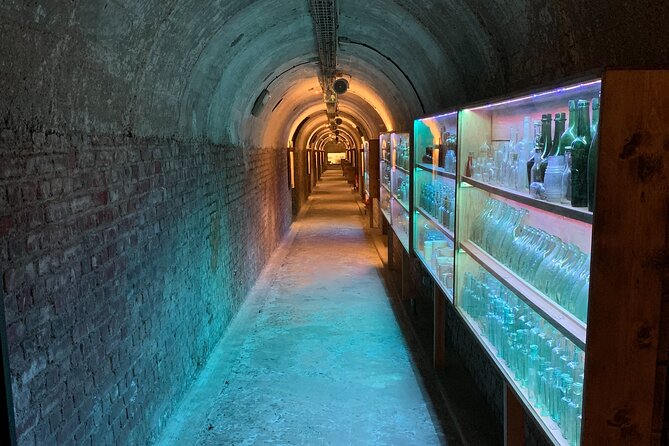
- A 250-meter underground entrance: The route begins beside Albert’s basilica and leads through a long tunnel 10 meters below the surface.
- Fifteen trench-warfare scenes: Reconstructed scenes use sound and light to show the conditions faced by soldiers in the Somme.
- Twenty-five display cabinets: Weapons, equipment, and other First World War objects give the museum substance beyond its dramatic effects.
- A Gallery of Heroes: The final section honors nine people who distinguished themselves during the war.
- A gentle outdoor finish: You leave through Albert’s public garden and can continue beside the Ancre River and its cascades.
- Good value for a short visit: At $9.67 per person, admission is modest, especially if you spend close to three hours examining the exhibits.
Arriving beneath Albert’s basilica
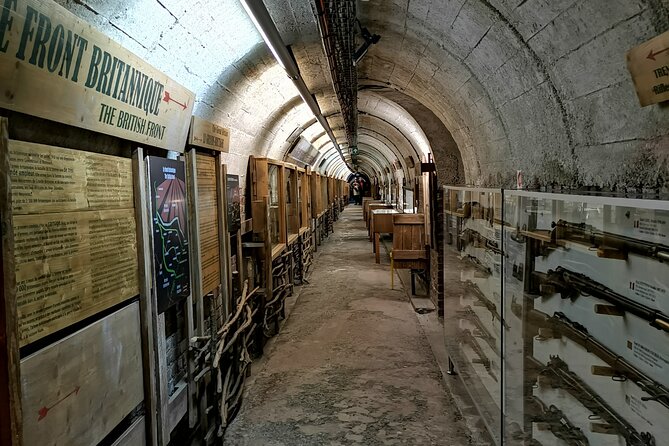
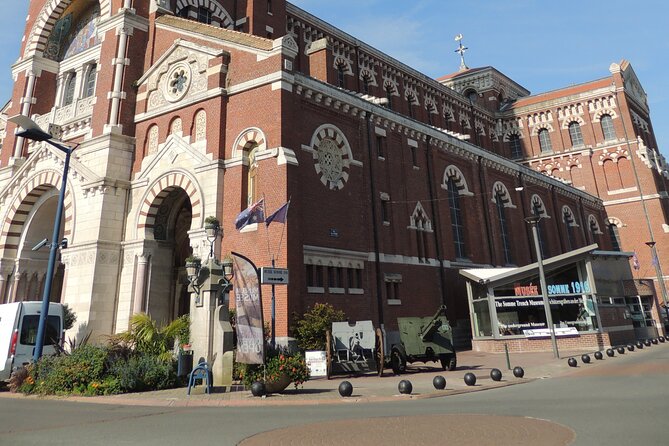
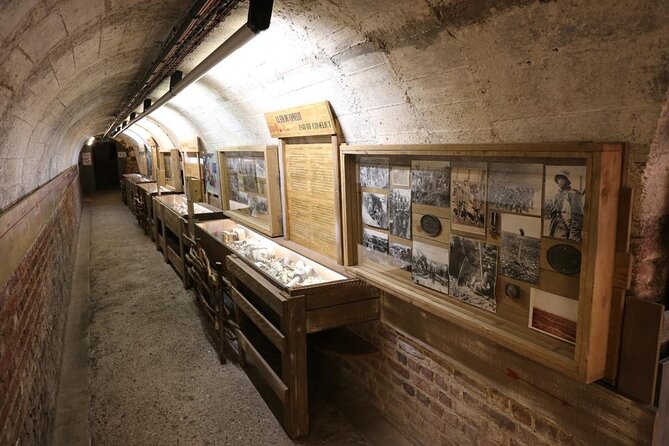
The museum begins in an unusual way. From the entrance hall beside the basilica, you descend into a tunnel that runs for 250 meters beneath the town. It sits about 10 meters below ground, so the approach feels more like entering a wartime shelter than walking into a standard museum.
That choice matters. Before you see a single display cabinet, the building has already changed your mood. You are leaving the ordinary streets of Albert and moving into a confined underground space. The setting gives the subject weight without requiring a long introduction from a guide.
The tunnel itself is not a battlefield trench, and you should not expect a full reconstruction of a soldier’s daily routine. Its value is symbolic and atmospheric. It prepares you for a museum focused on the human experience of the Somme rather than a simple collection of military objects.
Allow yourself time at the beginning. It is tempting to hurry through the tunnel because the main galleries seem to be ahead, but the underground route is one of the most distinctive parts of the visit. It also makes the museum a useful stop on a wider Somme battlefield day, when you may already have seen open fields, memorials, and cemeteries.
A few more France trips worth weighing up
- Paris: Louvre Museum Timed-Entrance Ticket
★ 4.6 · 71,977 reviews - Disneyland® Paris 1-Day Ticket
★ 4.6 · 49,412 reviews - Paris: Versailles Palace and Gardens Full Access Ticket
★ 4.6 · 41,579 reviews
Fifteen scenes that explain trench warfare
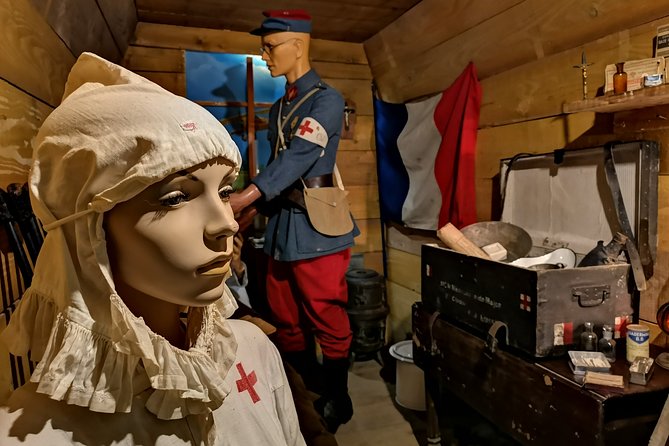
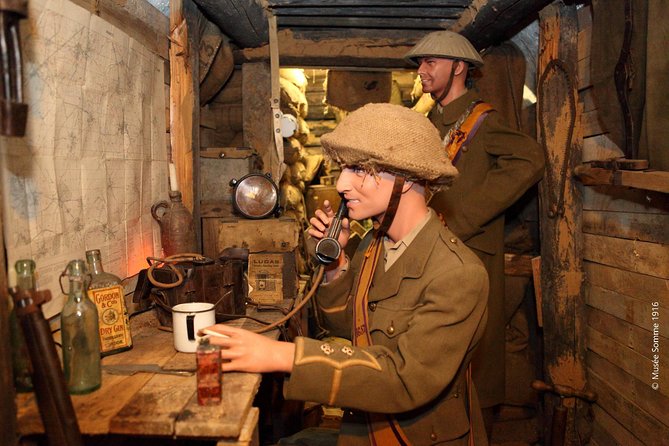
At the end of the tunnel, the museum presents fifteen separate alcoves devoted to trench warfare in the Somme. These scenes tell the story in small sections, which makes the visit easier to follow than one large, crowded exhibition.
The displays focus on wartime conditions and the struggles faced by soldiers. Sound and light effects add atmosphere, including realistic representations of bombardments. These effects help you imagine the violence and confusion of the front, though they may be intense for young children or anyone sensitive to sudden noise and dark environments.
I find this format useful because it gives you time to pause. You can examine one scene, think about what it is showing, then move to the next. The museum does not ask you to absorb a huge amount of information in one pass.
The displays also help families discuss the subject. One French-speaking parent described the museum as a meaningful act of remembrance for young children who became very interested in the material. That is a fair description, but I would still prepare children beforehand. The subject is death, destruction, and wartime suffering, not an entertaining military attraction.
A point worth keeping in mind is the balance of the storytelling. The reconstructed scenes often focus on those who died, while the experience gives less attention to soldiers who survived with severe physical and emotional injuries. If you want a full picture of the war’s long-term effects, you may find this emphasis somewhat limited.
Twenty-five cabinets filled with wartime objects
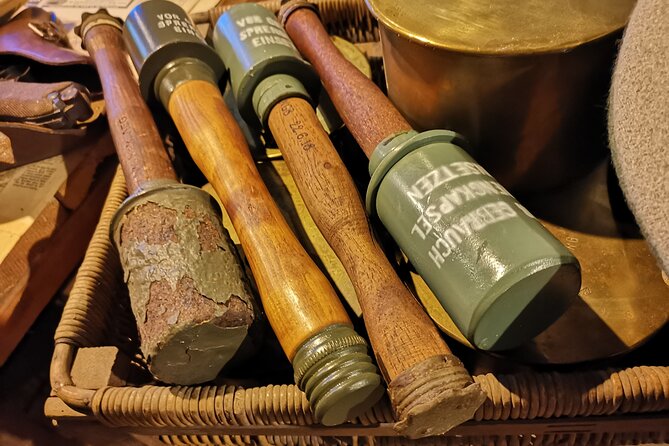
The museum’s 25 display cabinets provide the factual core of the visit. Here you can study First World War artifacts, weapons, and equipment at a slower pace. The objects give useful context to the reconstructed scenes and keep the museum from becoming only a sound-and-light presentation.
I like having both elements together. The alcoves appeal to your imagination, while the cabinets give you things to inspect closely. That combination is especially helpful if you want more than a general emotional impression of the Somme.
The displays are also a good reason not to rush. A quick visit could take about an hour, but you can spend up to three hours if you read carefully and examine the objects in each cabinet. The ticket does not include food, drinks, or transportation, so plan your time around your own schedule rather than expecting a hosted half-day tour.
The museum is accessible in four languages: English, French, German, and Dutch. That is a major practical benefit. You can focus on the historical material instead of trying to translate every label, and families or mixed-language groups can explore at a comfortable pace.
A new free app is also included with admission. The supplied information does not specify every feature of the app, so I would treat it as a useful extra rather than the main reason to book. The physical exhibits and underground setting carry the visit.
The Gallery of Heroes and the human cost
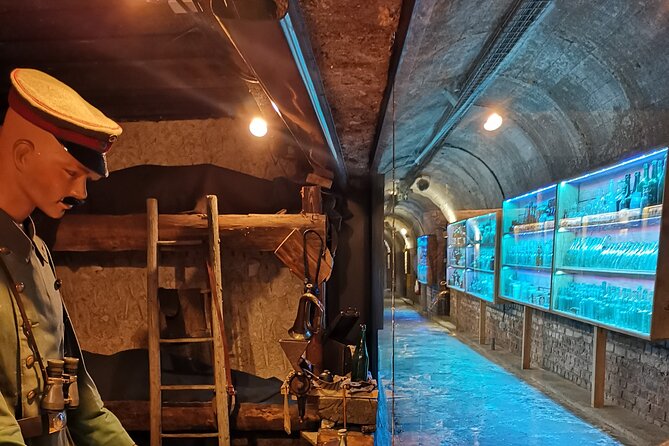
The final indoor section is the Gallery of Heroes. It is dedicated to nine individuals who distinguished themselves during the war. This gives the visit a more personal ending after the larger scenes of bombardment and trench warfare.
The gallery can help you connect military history with individual lives. Large battles are often reduced to troop movements and casualty figures, but individual stories make the period easier to understand as human history.
The Somme was one of the deadliest battles of the First World War. The first day alone saw 56,000 British soldiers killed, a figure that places the museum’s displays in stark context. The museum’s tone is not light, and that is appropriate for the subject.
Still, the Gallery of Heroes may leave you wanting a broader range of personal stories. The emphasis on distinguished individuals is moving, but war was also shaped by ordinary soldiers, civilians, medics, families, and the wounded. The museum gives you a concentrated introduction rather than a complete account of every side of the conflict.
I would visit with enough time afterward to sit quietly or walk outside. The museum deals with loss directly, and the transition to Albert’s gardens provides a welcome change of pace.
A completely different sort of day in France:
- Paris: Evening River Cruise with Music
★ 4.4 · 22,721 reviews - Paris: Eiffel Tower Entry Ticket with Optional Summit Access
★ 4.4 · 20,035 reviews - Paris: Eiffel Tower Summit or Second Floor Access
★ 4.3 · 17,248 reviews - Paris: Louvre Guided Tour with Reserved Access & Boat Cruise
★ 4.3 · 16,353 reviews
Leaving through the Arboretum beside the Ancre
You do not exit through the same entrance. The route leads through the museum shop and then into Albert’s public garden. From there, you can explore the Arboretum, where the Ancre River flows past cascades.
This outdoor finish is one of the experience’s best small touches. After the confined tunnel and dark wartime scenes, the open garden gives you room to breathe and think. The river and cascades also offer attractive views that soften the end of a serious visit.
Do not treat the exit as an afterthought. If the weather is pleasant, allow extra time for the Arboretum rather than walking straight back to your vehicle or onward transportation. The combination of museum and garden creates a more complete visit than an underground exhibition alone.
The outdoor area is public, so it is not part of a guided walk with a fixed schedule. You can continue at your own pace. The museum itself may take from one to three hours, depending on how carefully you read the displays and how long you spend outdoors.
Is $9.67 good value?
At $9.67 per person, this is a reasonably priced admission ticket. You receive entry to the entire museum, access to its four-language presentation, and the new free app. Transportation, food, and drinks are not included, but the low ticket price leaves room in your budget for getting to Albert and continuing your day in the Somme area.
The value is strongest if you enjoy museums that combine atmosphere with objects and interpretation. You are not paying for a long guided excursion or a packed schedule of battlefield stops. You are paying for a focused museum visit that can fit into a larger day.
It is also good value for families and mixed-age groups because the visit is self-paced. Some people can spend more time with the cabinets, while others can move more quickly through the alcoves. Children must be accompanied by an adult, but most people can participate and there are no stated health restrictions.
The group capacity is listed at a maximum of 15 people. That suggests a more manageable setting than a large attraction, though the ticket itself is not described as a guided small-group tour. You should think of it as independent museum admission rather than a private experience.
Planning your time in the Somme area
The museum is open daily from 9:00 a.m. to 6:00 p.m. for the stated period from January 25 through December 31, 2026. Those hours give you flexibility, but you still need to consider the distance from Amiens.
The location note is important. If you are staying in Amiens, the museum is not in the city center. It is in Albert, about 20 miles beyond Amiens, so transportation to and from the attraction is your responsibility.
Because of that distance, I would not book it as a quick Amiens walking stop. Pair it with other Somme sights if you are already exploring the battlefield region, or plan enough time for the journey so the museum does not become a rushed detour.
The experience is booked an average of 19 days ahead, which suggests that advance planning is sensible during busy periods. Confirmation is provided at booking, and free cancellation is available if you cancel at least 24 hours before the scheduled start time. Changes or cancellations made inside that 24-hour window are not accepted for a refund.
Who will appreciate this museum most?
I would recommend the Musée Somme 1916 to several kinds of visitors:
- First World War students: The artifacts, reconstructions, and personal stories provide a clear introduction to the Somme.
- Families with older children: The format is visual and atmospheric, though adults should explain the serious subject matter in advance.
- Visitors interested in battlefield history: The museum gives useful background before or after seeing sites in the surrounding region.
- People who prefer self-guided visits: You can move through the galleries at your own speed, with four language options and a free app.
- Photographers and walkers: The Arboretum and Ancre River offer a pleasant outdoor ending.
I would be more cautious if you dislike underground spaces, realistic bombardment effects, or exhibitions centered on death. The museum is not designed as a cheerful family attraction. Its strength is also its limitation: it makes the horror of war feel close.
Practical tips for a better visit
Read the language options before you begin so you know which format suits you best. English is available, along with French, German, and Dutch, so you should not need to rely on guesswork or partial translations.
Set aside at least an hour, and closer to three hours if you want to study all 25 cabinets, take your time in the 15 alcoves, visit the Gallery of Heroes, and walk through the Arboretum.
Wear clothing suitable for an underground museum and an outdoor garden visit. Specific temperature information is not provided, but the route includes a long subterranean tunnel followed by time outside beside the river.
Keep children close during the sound and light sequences. The displays portray bombardments in a realistic way, and the subject matter includes death and severe wartime suffering.
Finally, remember that the ticket covers admission only. You will need to arrange your own transportation and buy any food or drinks separately.
Should you book the Musée Somme 1916 ticket?
I would book it if you want a focused, affordable introduction to the Somme and you are already planning to visit Albert or the surrounding First World War sites. The underground tunnel, 15 reconstructed scenes, 25 display cabinets, and Gallery of Heroes give the experience enough substance for more than a quick photo stop.
The strongest reasons to go are the atmospheric underground setting, the clear multilingual access, and the thoughtful walk into Albert’s Arboretum at the end. The main drawbacks are the distance from Amiens, the lack of included transportation, and the museum’s heavy focus on death rather than the full range of wartime experiences.
At $9.67, it is an easy addition to a Somme itinerary. Just plan the journey carefully, give yourself time to process the subject, and leave room for the Ancre River walk afterward.
FAQ
Where is the Musée Somme 1916 located?
The museum is in Albert, in the Somme area of France. It is described as roughly 20 miles past Amiens, despite being marketed for visitors in the Amiens area.
How much does admission cost?
Admission costs $9.67 per person.
How long does the visit take?
The visit takes approximately one to three hours, depending on how carefully you explore the exhibits and whether you spend time in the Arboretum afterward.
What languages are available?
The museum is accessible in French, English, German, and Dutch.
What is included with the ticket?
The ticket includes museum admission and access to the new free app.
Is transportation included?
No. Transportation to and from the attraction is not included.
Can children visit the museum?
Yes. Children can visit, but they must be accompanied by an adult.
Can I cancel for a refund?
Yes. You can cancel at least 24 hours before the experience start time for a full refund. Cancellations or changes made less than 24 hours in advance are not accepted for a refund.
Recently added around France
- The essential in Bordeaux, private tour with a local★ 4.9 · 48 reviews
- Avignon, Les Baux, St Remy and Arles from MARSEILLE★ 4.5 · 48 reviews
- Private Half-Day Guided Tour of Paris★ 4.5 · 48 reviews
- Visit Avignon and Villeneuve lez Avignon aboard a Double-Decker Bus★ 4.0 · 48 reviews
- 2 hour outdoor group activity in Paris: SAINT GERMAIN★ 5.0 · 48 reviews
- Blind Test Room & karaoke Montpellier★ 5.0 · 48 reviews
- Paris Dinner Show Opera Bel Canto★ 4.5 · 48 reviews
- Cannes: Lérins Islands Private Boat Tour★ 4.9 · 48 reviews
Tickets, compared.

Paris: Versailles Palace and Gardens Full Access Ticket
Read our review →
Paris: Eiffel Tower Entry Ticket with Optional Summit Access
Read our review →
Paris: Moulin Rouge Cabaret Show Ticket with Champagne
Read our review →
Paris: Montparnasse Tower Observation Deck Entry Ticket
Read our review →
Paris: Louvre Museum Entry Ticket With Host and River Cruise
Read our review →