
Reviewed · LOUVRE MUSEUM TOURS
The Essential Louvre Masterpieces Tour – Limited to Six Guests
The Louvre is too big for guesswork. This six-person tour takes you from ancient sculpture to the Mona Lisa in about two and a half hours, with an expert English-speaking guide to keep the route moving and explain what you are seeing. I like the small group size, and I like that the visit covers more than the usual Mona Lisa photo stop.
I also like the choice of morning or afternoon departures. Guides such as Lily, Violette, Adam, Ivana, Barbara, Lu, Erell, and Tina have been praised for clear explanations, friendly teaching, and the ability to adjust their approach for children, first-time museum visitors, and serious art fans.
The main consideration is price. At $192.36 per person, this is not a cheap museum entry ticket, even though the adult admission fee of €28 is included. You are paying for the guide, the route planning, the small group, and the time saved inside one of Europe’s most confusing museums.
In This Review
- Key Points Before You Book
- Why Six People Is the Right Size for the Louvre
- Starting at the Louvre’s Foundations
- Venus de Milo and the Greek Sculpture Collection
- Winged Victory of Samothrace and a Dramatic Museum Moment
- An Original Louvre Room and the Move Toward Renaissance Art
- Reaching the Mona Lisa Without Losing the Plot
- Guides Who Make Art Easier to Understand
- Is $192.36 a Fair Price?
- Timing, Meeting Point, and What to Bring
- Who Will Get the Most From This Tour?
- Cancellation and Booking Details
- Should You Book the Essential Louvre Masterpieces Tour?
- FAQ
- How long does the Louvre tour last?
- How many people can join the tour?
- Is Louvre admission included?
- Is the tour offered in English?
- Which Louvre artworks are included?
- Can I choose a morning or afternoon tour?
- Can I cancel for a full refund?
Key Points Before You Book
- A maximum of six people makes it easier to hear the guide, ask questions, and see the artwork without following a large crowd.
- The route links several major periods, from Greek and Roman sculpture to Etruscan art and the Italian Renaissance.
- Venus de Milo, Winged Victory of Samothrace, and the Mona Lisa are central highlights, but the tour also includes less familiar rooms and objects.
- Guides teach you how to look, explaining symbolism, technique, artistic choices, and the differences between Greek and Roman sculpture.
- Families can benefit from the personal approach, with past tours praised for engaging children aged 11, 14, and 15.
- The museum is physically demanding, and strollers or pushchairs cannot be used on the semi-private tour.
Why Six People Is the Right Size for the Louvre
The Louvre is not simply a large museum. It is a former palace with long corridors, several wings, grand staircases, and collections that can easily swallow your day. Without a plan, you may spend half your visit checking maps and still miss the rooms you came to see.
A group capped at six gives the guide room to do more than recite facts. You can ask why a sculpture looks distinctly Roman, what a painting’s symbols mean, or how the Louvre’s buildings developed over time. The guide can also pause long enough for you to actually look.
The small format matters most around famous works. The Mona Lisa is a major stop, and the Louvre can feel crowded near its best-known pieces. A compact group is easier to keep together and easier to position so you can listen without being buried behind a wall of people.
This is described as a semi-private tour, with a private upgrade available. In some cases, a booking has ended up with only one party and the guide. That is not something you should assume will happen, but it shows how personal the experience can feel when the group is smaller than the maximum.
More Louvre visits and skip-the-line options:
- Paris: Louvre Museum Timed-Entrance Ticket
★ 4.6 · 71,977 reviews - Paris: Louvre Guided Tour with Reserved Access & Boat Cruise
★ 4.3 · 16,353 reviews - Louvre Museum Masterpieces Guided Tour with Access
★ 4.5 · 12,023 reviews
Starting at the Louvre’s Foundations
The meeting point is 8 Place du Carrousel, 75001 Paris, near the Louvre. The visit itself remains inside the Louvre Museum and lasts approximately two hours and 30 minutes, with admission included.
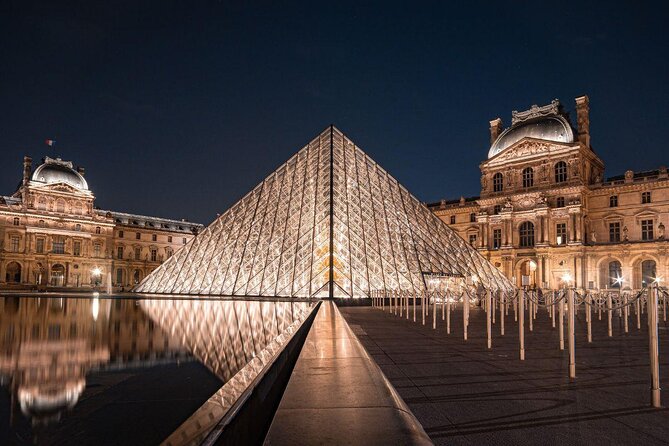
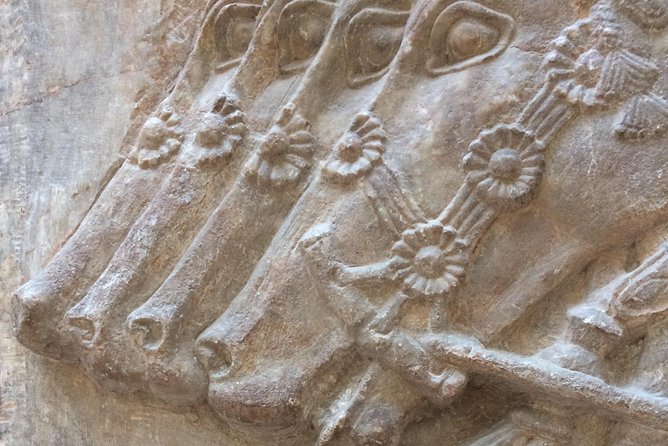
One of the more unusual early elements is the chance to see parts of the Louvre’s original foundations and moat. The building began as a fortress, and traces of that earlier purpose remain beneath the palace galleries. This gives you a useful frame for the museum: you are not walking into a purpose-built art center, but through layers of royal, military, and cultural history.
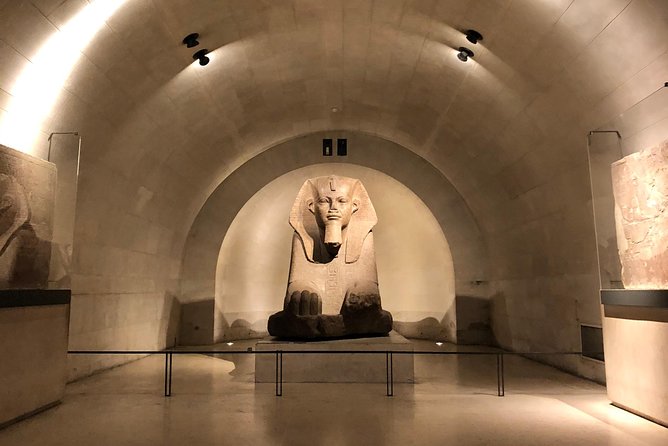
A visit to an Egyptian sphinx is also included according to the route described by past participants. The tour does not treat the Louvre as a single parade of famous paintings. It uses the building and its collections to show how art and power changed across centuries.
That approach is valuable because the Louvre can otherwise feel like a pile of disconnected rooms. A guide helps turn the museum into a story with a beginning, middle, and direction.
Venus de Milo and the Greek Sculpture Collection
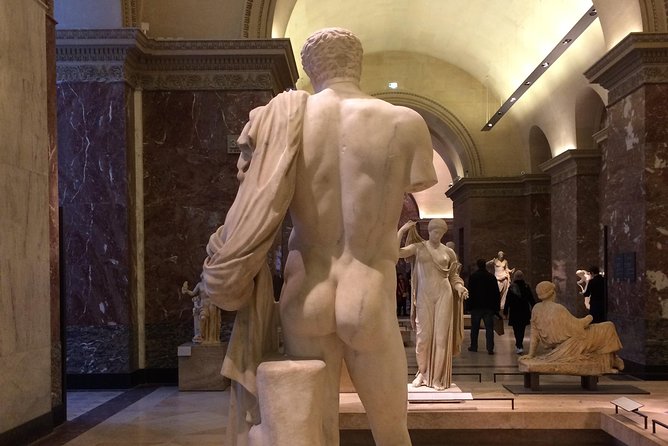
The tour moves into ancient sculpture and brings you to the Venus de Milo. This is one of the Louvre’s most recognizable works, but simply seeing it is only part of the experience.
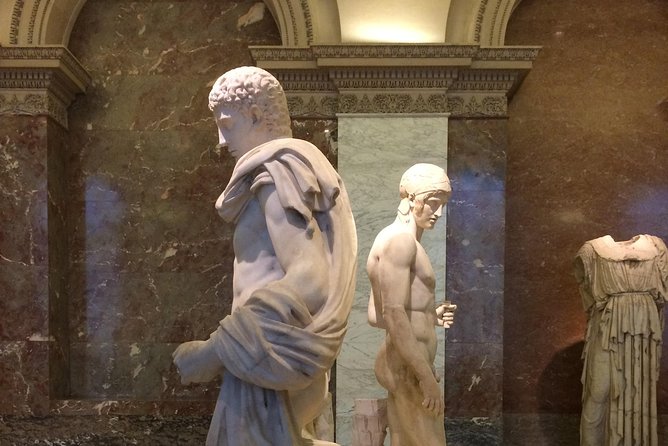
The guide compares Greek, Roman, and other sculptural traditions, giving you a way to examine details instead of treating every marble figure as the same. You might look at the pose, surface, proportions, idealized body, or the relationship between the figure and its missing or reconstructed elements.
This is one of the strongest reasons to take the tour rather than walk straight to the famous pieces alone. Greek and Roman sculpture can seem similar at first glance, especially when you are trying to move through a large gallery quickly. A good explanation helps you notice the artistic and cultural differences.
The route also moves through Roman sculpture and the Etruscan collection. The Etruscan material may not be the first thing on your personal must-see list, but it adds range to the visit. You get a sense of how artistic traditions in and around the ancient Mediterranean did not develop in a single straight line.
If you already have a strong background in classical art, you may want more time with individual works than this itinerary allows. For most first-time visitors, though, the comparisons make the ancient galleries more accessible.
Winged Victory of Samothrace and a Dramatic Museum Moment
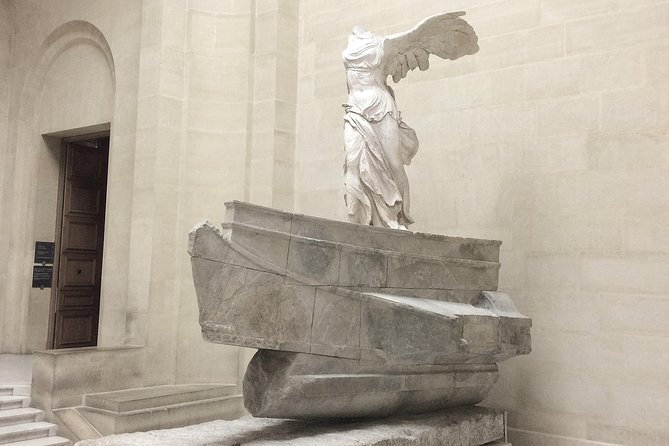
The introduction to antiquity culminates with the Winged Victory of Samothrace. Its position at the top of the Daru staircase makes it one of the Louvre’s most powerful encounters, even before you study its details.
The sculpture’s missing head and arms do not make it feel incomplete in the usual sense. Its forward movement, spread wings, and placement above the staircase create a strong sense of arrival. A guide can help you consider how the statue works not only as an object, but also as a carefully staged sight within the museum.
This is a good example of why route planning matters. You are not merely ticking off an ancient statue. You are moving toward a major visual moment, then using it to shift from ancient art toward later European painting.
The staircase and walking involved can be tiring, especially for anyone with physical limitations. One past participant specifically praised a guide for being considerate of physical needs, but you should still expect a moderate level of fitness for the semi-private tour.
A few more Paris trips worth weighing up
- Disneyland® Paris 1-Day Ticket
★ 4.6 · 49,412 reviews - Paris: Versailles Palace and Gardens Full Access Ticket
★ 4.6 · 41,579 reviews - Paris: Evening River Cruise with Music
★ 4.4 · 22,721 reviews - Paris: Eiffel Tower Entry Ticket with Optional Summit Access
★ 4.4 · 20,035 reviews
An Original Louvre Room and the Move Toward Renaissance Art
The route includes one of the few rooms left in its original condition. This detail gives the visit a welcome change of pace after the famous sculptures.
Instead of looking only at individual artworks, you get a sense of the Louvre as a historic residence and working royal space. The original room helps explain why the museum’s interiors can feel as important as the paintings on its walls.
From there, the tour moves toward the Italian Renaissance. This transition is one of the itinerary’s best teaching opportunities because the change in style happened over a relatively short period. You can watch artists move toward new approaches to space, human anatomy, composition, and expression.
The guide’s role here is not just to identify a painting. The strongest guides connect formal details with the period that produced them. Lily was praised for explaining symbolism and historical context, while other guides have been praised for asking questions that made participants examine the works more closely.
That interactive style can make a difference. Instead of hearing a long speech, you may be asked what you notice first, where your eye goes, or why an artist arranged a scene in a certain way.
Reaching the Mona Lisa Without Losing the Plot
The route ends at the Mona Lisa, but the painting works better as the final point of a wider visit than as the entire purpose of the tour.
You will see one of the world’s most famous paintings in person, yet you will also understand more about the artistic changes that led toward Leonardo’s work. The guide can discuss the painting’s place in the Italian Renaissance and explain details that are difficult to notice in a crowded room.
Be realistic about the viewing conditions. The Mona Lisa is a high-demand sight, and you may have limited time or space near the painting. The value of the tour is not that it transforms the room into a private viewing. The value is that you arrive with context, know what to look for, and do not waste your limited Louvre time wandering between wings.
The route is designed to finish at the Mona Lisa, so you should not expect to see every major department. The Louvre would require far more than one morning or afternoon to explore properly. This is a focused introduction, not a complete museum survey.
Guides Who Make Art Easier to Understand
The strongest theme across the feedback is the quality of the guides. Violette is described as a trained professional guide with a background in art history, and she has been praised for explaining lesser-known works, managing crowds, and speaking fluent English.
Adam receives especially strong praise for his use of questions and discussion. He has helped repeat Louvre visitors see more than they remembered from earlier trips, and he has been praised for making art appealing to both adults and younger family members.
Lily is noted for detailed explanations of symbolism and historical context. Tina has been praised by an art teacher for combining serious knowledge with explanations that made sense to a less art-focused companion.
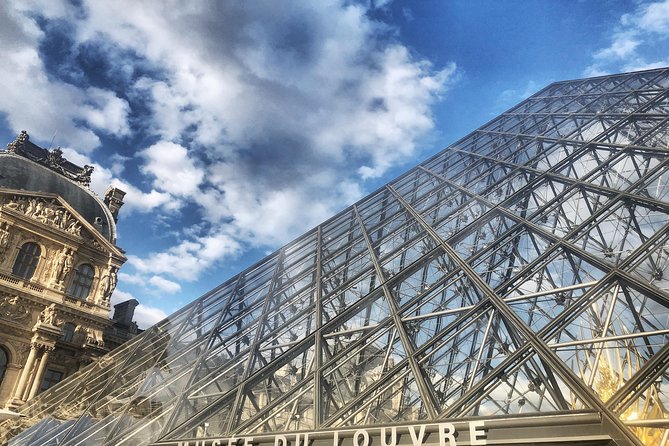
Barbara has explained subjects ranging from the Louvre’s development as a fortress to the museum’s pyramid and the preservation of color in old paintings. Lu has been praised for bringing objects to life through detailed stories, while Erell has been appreciated for both museum guidance and useful restaurant suggestions.
You may not receive a particular guide unless the company confirms that in advance. The important point is that the tour uses guides with different strengths, including art history, museum navigation, family engagement, and discussion.
Is $192.36 a Fair Price?
The price is high compared with entering the Louvre on your own. The included adult admission is listed as €28, so much of the remaining cost reflects the guide service and the small-group format.
I would judge the value by your time in Paris. If you have only one day for the Louvre, paying for direction can prevent hours of wrong turns and indecision. The tour also helps you get more from the works you do see, which is often more useful than rushing through twice as many rooms without context.
The value is less clear for repeat visitors who already know the Louvre’s layout and have a firm list of galleries to explore. You may prefer a standard ticket and several hours at your own pace.
For families, couples, and first-time visitors, the price can make more sense. The guide can answer questions, adjust explanations, and keep the group moving. Several families found that the experience worked for children and teenagers, especially because the guides made the art conversational rather than overly formal.
Group discounts are available, and a private upgrade can be selected. Check the final booking price and conditions before paying, since the advertised figure is per person.
Timing, Meeting Point, and What to Bring
You can choose a morning or afternoon departure. Morning is a sensible choice if you want the rest of the day for another Paris sight, though the best option depends on your schedule and energy.
The meeting point is at 8 Place du Carrousel. The end point is the Louvre Museum in the same general area, and hotel pickup and drop-off are not included. The location is near public transportation, so plan to arrive with enough time to find the exact meeting spot.
Bring your mobile ticket and valid identification if you may qualify for free admission. Free entry applies to visitors under 18 and to residents of the European Economic Area under 26, with valid identification and proof of residency.
Keep your luggage light. The Louvre does not allow large backpacks or luggage, and strollers or pushchairs cannot be accommodated on the semi-private tour. Wear comfortable shoes and expect moderate physical activity through a large museum with considerable walking.
Food and drinks are not included. If you want lunch afterward, the Café Marly near the Louvre has been praised as a pleasant option overlooking the courtyard, though the premium setting comes with premium prices.
Who Will Get the Most From This Tour?
I would recommend this experience to:
- First-time Louvre visitors who want a clear route
- Couples who prefer discussion over a large-group lecture
- Families with older children or teenagers
- Art lovers who want context, not just famous names
- Visitors with limited time in Paris
- People who find large museums confusing or tiring to navigate
It is less suitable if you want to spend a full day in one department, work independently, or use a stroller. It may also feel too fast if you want extended time sketching, reading labels, or studying a small number of works in detail.
The format is best for seeing the Louvre’s major story in one concentrated visit. It gives you a useful first map of the museum, even if you later return to explore more slowly.
Cancellation and Booking Details
Confirmation is provided at booking. You can cancel for a full refund if you do so at least 24 hours before the local start time.
Changes or cancellations made less than 24 hours before the experience are not accepted for a refund. The tour also requires a minimum number of participants, so if the operator cancels because that minimum is not met, you will be offered another date or experience, or a full refund.
The experience is offered in English and has a maximum of six participants.
Should You Book the Essential Louvre Masterpieces Tour?
Book it if you want to see the Louvre’s most important works without spending your first visit lost in its corridors. The combination of small-group access, an art-focused guide, and a carefully connected route from ancient sculpture to the Mona Lisa gives you more than an entry ticket.
I especially recommend it for a short Paris stay, a family visit, or anyone who wants art explained in plain language. The price is substantial, but the time saved and the quality of interpretation can justify it.
Skip it if you already know the Louvre well, need a stroller, or prefer a slow independent visit. For everyone else, this is a focused and practical way to meet the museum without letting its size take over your day.
FAQ
How long does the Louvre tour last?
The tour lasts approximately two hours and 30 minutes.
How many people can join the tour?
The semi-private tour has a maximum of six participants.
Is Louvre admission included?
Yes. The adult museum entrance fee, listed as €28, is included in the tour price.
Is the tour offered in English?
Yes. An expert English-speaking guide leads the experience.
Which Louvre artworks are included?
The route includes the Venus de Milo, Roman sculptures, the Etruscan collection, the Winged Victory of Samothrace, Italian Renaissance works, and the Mona Lisa. It also includes an original Louvre room and, according to the described route, an Egyptian sphinx and parts of the original foundations and moat.
Can I choose a morning or afternoon tour?
Yes. Morning and afternoon tour options are available.
Can I cancel for a full refund?
Yes. You can receive a full refund by canceling at least 24 hours before the experience start time. Cancellations or changes made less than 24 hours before the start time are not accepted.
Recently added around Paris
- Private Half-Day Guided Tour of Paris★ 4.5 · 48 reviews
- 2 hour outdoor group activity in Paris: SAINT GERMAIN★ 5.0 · 48 reviews
- Paris Dinner Show Opera Bel Canto★ 4.5 · 48 reviews
- Paris Vintage Tour by Night on a Sidecar with Champagne★ 5.0 · 48 reviews
- Secrets & Scandals of the Louvre – Limited to 6 Guests★ 5.0 · 48 reviews
- Paris Photoshoot: Eiffel Tower Exclusive Private Experience★ 5.0 · 48 reviews
- Paris: Louvre Mona Lisa Discovery Guided Tour with Ticket★ 4.9 · 48 reviews
- From Paris: Versailles Full-Day Guided Tour with Lunch★ 4.9 · 48 reviews
Louvre Museum Tours, compared.


Paris: Louvre Guided Tour with Reserved Access & Boat Cruise
Read our review →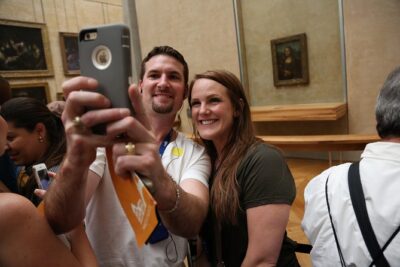
Louvre Museum Masterpieces Guided Tour with Access
Read our review →
Paris: Louvre Museum Entry Ticket With Host and River Cruise
Read our review →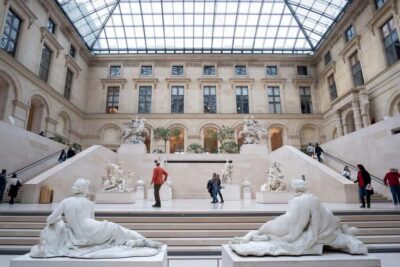
Paris: Priority Access Louvre with Host -Direct to Mona Lisa
Read our review →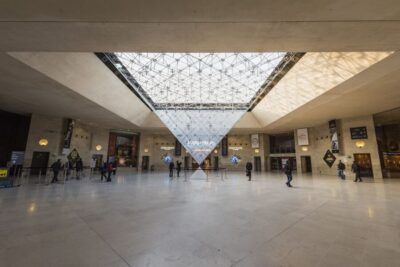
Mona Lisa & Louvre Masterpieces Tour with Reserved Access
Read our review →
Louvre Museum – Exclusive Guided Tour (Entry Included)
Read our review →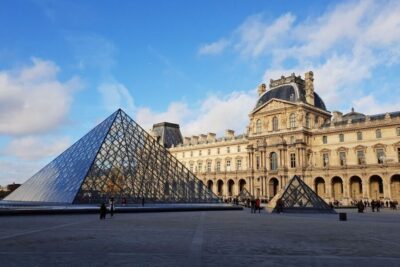
Paris: Louvre Reserved Ticket and River Cruise Combo
Read our review →Browse the lists this tour appears in