
Reviewed · MUSEUMS
Entrance ticket to the Escoffier Culinary Art Museum
A great chef’s birthplace makes a smart stop. The Escoffier Culinary Art Museum gives you a close look at Auguste Escoffier, one of France’s most influential chefs, inside the 18th-century Provençal house where he was born. I like the personal setting and the museum’s mix of menus, kitchen furniture, souvenirs, and edible-looking sculptures. I also like the low price, about $8.47 per person. The main drawback is its short opening break in the afternoon, plus the fact that an audioguide costs extra.
This is not a long attraction, and that is part of its appeal. You can see the museum in about 45 minutes, making it easy to add to a day in Villeneuve-Loubet or the French Riviera. The museum has earned a 4.9 rating from 298 reviews, with 100 percent recommending it, and the praise centers on the well-kept displays and friendly staff.
In This Review
- Key points to know before you go
- Why Escoffier matters to French food
- Entering the 18th-century Provençal house
- Ten rooms and 300 square meters of food culture
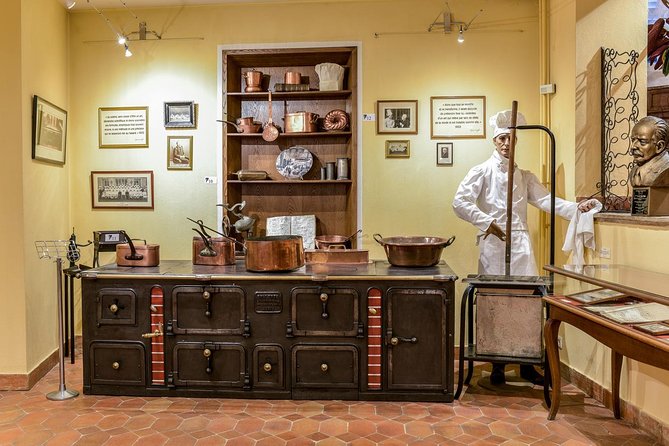
- The old kitchen furniture and working world
- Sugar, chocolate, and the museum’s playful side
- The temporary exhibition changes the visit
- How long to allow for the museum
- Is the $8.47 admission good value?
- Practical timing, transport, and physical effort
- Who will enjoy this museum most?
- Booking and cancellation advice
- Should you book the Escoffier Culinary Art Museum?
- FAQ
- Where is the Escoffier Culinary Art Museum?
- How much does admission cost?
- How long does a visit take?
- What does the admission ticket include?
- Is an audioguide included?
- What are the museum’s opening hours?
- Is the museum near public transportation?
- When is the museum closed for its annual closure?
- Can I cancel for a full refund?
Key points to know before you go
- Auguste Escoffier’s birthplace: The museum occupies the 18th-century Provençal house where the famous chef was born.
- Ten exhibition rooms: About 300 square meters hold personal objects, old kitchen furnishings, menus, and culinary art.
- A rare museum subject: It is described as the only museum of culinary art in France.
- Sugar and chocolate sculptures: These displays add a visual treat beyond portraits and kitchen tools.
- A short, flexible visit: Plan on roughly 45 minutes, with opening hours from 10 a.m. to 1 p.m. and 2 p.m. to 6 p.m.
- Good value for a specialist museum: Admission costs about $8.47 per person, and free cancellation is available up to 24 hours ahead.
Why Escoffier matters to French food
Auguste Escoffier is presented here not simply as a celebrity chef, but as a major figure in French gastronomy. He is remembered as humanist, inventive, and visionary, and the museum connects those qualities to the work and objects he left behind.
You do not need to be a serious cook to appreciate the visit. The museum is about the people, tools, habits, and presentation behind French cuisine. If you enjoy food culture, old household objects, or the story of how professional cooking developed, you will find more here than a quick portrait of one famous man.
The museum’s focus also gives your French Riviera trip some useful variety. The region is known for coastal scenery and resort towns, but a food museum in a historic village offers a different view of local culture. It puts attention on craft, discipline, hospitality, and the traditions that helped shape French cooking.
More Museum Tours in Nice:
- Nice: Allianz Stadium and National Sports Museum Tour
★ 4.5 · 301 reviews - Paris: Louvre Museum Timed-Entrance Ticket
★ 4.6 · 71,977 reviews - Louvre Museum Masterpieces Guided Tour with Access
★ 4.5 · 12,023 reviews
Entering the 18th-century Provençal house
The setting does much of the work. Instead of placing Escoffier’s belongings in a modern gallery, the museum allows you to move through the rooms of the house he once occupied. That gives the visit a more direct connection to his life.
I like this kind of museum because the building helps explain the person. You are not only looking at objects behind glass. You are also seeing the domestic setting connected with Escoffier’s early life, in the village of Villeneuve-Loubet.
The house is in the heart of the village, which makes the museum a natural stop during a walk through town. Its location near public transportation is useful if you are not driving, though the available information does not specify the exact bus or train route. Check your route before setting out, especially if you are building the visit around a tight Riviera schedule.
Ten rooms and 300 square meters of food culture
The museum spreads its displays across ten exhibition rooms covering about 300 square meters. That is enough space for a varied visit, but not so much that the subject becomes tiring.
You can expect the rooms to combine several types of material:
- Personal souvenirs connected with Escoffier
- Objects used by the chef
- Kitchen furniture from an earlier period
- Collections of menus
- Sugar sculptures
- Chocolate sculptures
- A yearly temporary exhibition with a changing theme
This mixture is important. A museum devoted only to a chef’s biography could feel narrow. Here, the objects broaden the story and show how food connects with design, service, equipment, and ceremony.
The menu collection is especially useful for understanding how meals were presented and recorded. Menus can reveal what people ate, how dishes were named, and how dining functioned as a social event. They also bring a visual element to the visit that balances the more practical kitchen displays.
The old kitchen furniture and working world
The antique kitchen furniture helps you picture the work behind formal French cooking. You can compare these earlier furnishings with the highly organized professional kitchens that Escoffier helped influence.
The available information does not provide a full inventory of every object, so you should not expect a detailed catalog of individual pieces before arrival. Still, the presence of period furniture gives the museum a practical angle. You see cooking as labor and organization, not just as a finished plate in a restaurant.
I find this useful for families and casual food fans. Children may respond more readily to large kitchen objects and colorful sculptures than to long written panels about culinary theory. Adults who cook can spend time studying the tools and furniture, while people with little kitchen interest can focus on the house, the displays, and the visual details.
A few more Nice trips worth weighing up
- From Nice: French Riviera in One Day
★ 4.5 · 5,215 reviews - Nice: 1-Hour Sightseeing Cruise to Villefranche Bay
★ 4.6 · 2,747 reviews - Nice: 1 or 2-Day Hop-On Hop-Off Bus Tour
★ 4.3 · 2,663 reviews - Nice: Gorges of Verdon and Fields of Lavender Tour
★ 4.4 · 1,975 reviews
Sugar, chocolate, and the museum’s playful side
The sugar and chocolate sculptures are among the most distinctive parts of the visit. They show that culinary art can be visual as well as edible, with chefs and confectioners treating ingredients as materials for design.
These pieces also keep the museum from feeling too formal. Historical objects and menus can sometimes make a small museum seem serious from beginning to end. Sculptures made from sugar and chocolate add color and imagination, giving you something immediately eye-catching as you move through the rooms.
The supplied information does not describe the exact subjects or sizes of the sculptures, and displays may change. It is best to think of them as a highlight of the museum’s artistic side rather than expect a fixed collection of particular works.
The temporary exhibition changes the visit
Each year, the museum presents a temporary exhibition devoted to a particular theme. This gives repeat visitors a reason to return and adds a changing layer to the permanent displays.
For a first visit, the temporary show can help you see Escoffier’s world from a fresh angle. The permanent rooms introduce his life and work, while the temporary exhibition may focus attention on a specific food, technique, period, or related subject. The theme is not provided here, so check the current program if that feature matters to your plans.
This yearly change also makes the museum more than a one-time memorial. It suggests an active cultural program rather than a room of fixed objects. Still, your visit should not depend entirely on the temporary display unless you confirm what is showing before booking.
How long to allow for the museum
The stated visit length is about 45 minutes. That makes the museum an easy addition to a larger day, especially if you have only a short window between other activities.
You can move through the rooms at a steady pace in that time. If you read every panel carefully, study the menus, or spend extra time with the sculptures, you may want to allow longer. The museum does not require a full morning or afternoon, but it rewards visitors who resist rushing.
The split opening hours matter more than the short visit length. The museum opens from 10 a.m. to 1 p.m., then closes and reopens from 2 p.m. to 6 p.m. If you arrive shortly after 1 p.m., you will need to wait until 2 p.m. Plan your meal or village walk around that pause.
Because the visit is compact, I would place it beside another Villeneuve-Loubet activity rather than make it the only reason for a long journey. Its strongest use is as a focused cultural stop that adds meaning to your time in the village.
Is the $8.47 admission good value?
At about $8.47 per person, admission is modest for a specialist museum with ten rooms and a substantial collection of objects. You are paying for access to a historic house, a focused Escoffier collection, culinary displays, and a temporary exhibition program.
The value is strongest if you already plan to be in Villeneuve-Loubet. You can enjoy the museum without giving up several hours, and its subject is specific enough to feel different from a standard regional history museum.
The price is less compelling if you have no interest in food, chefs, historic interiors, or decorative art. The museum is not described as a tasting experience, and the admission does not include an audioguide. If you expect a meal, cooking demonstration, or guided lesson, this ticket will not meet that expectation.
I see the admission as a low-risk purchase for food lovers and curious visitors. The high rating of 4.9 from 298 reviews supports that judgment, while the strongest praise focuses on the museum being well maintained and the staff being friendly. That personal welcome matters in a small museum, where a cold or neglected presentation would quickly spoil the visit.
Practical timing, transport, and physical effort
The museum is near public transportation, so you do not need to assume that a car is essential. Exact transport details are not supplied, so use a current local route planner and allow time for the final walk to the museum in the village center.
A moderate level of physical fitness is recommended. The information does not specify the number of stairs, seating, or step-free access, so contact the museum directly if you have particular mobility needs. The building is an 18th-century house, which may mean that movement is less straightforward than in a new purpose-built museum, but no specific barriers are confirmed.
A mobile ticket makes entry simple. Keep it accessible on your phone, and check the confirmation for the selected date and start time. Since the museum operates on a daily schedule but closes from 1 p.m. to 2 p.m., the exact time still matters.
The annual closure is another key planning point. The museum is closed from December 1, 2025, through January 8, 2026, inclusive. If you are visiting during that period, do not build your itinerary around this stop.
Who will enjoy this museum most?
I would recommend the museum first to people who enjoy French food, culinary history, chefs, historic houses, or decorative sugar work. It also suits visitors looking for a short cultural activity that does not consume a whole day.
Families may like the sculptures and the variety of objects, though the information does not confirm child-specific activities. Couples and solo visitors can treat it as a calm stop between meals, walks, or other Riviera sights.
It is also a good choice for anyone who wants a more local-feeling experience than a large headline attraction. The museum’s subject is narrow, but that is its strength. You get a clear look at one important figure and the world connected with him.
I would be more cautious if you dislike museums with written displays or if you want an interactive cooking activity. No cooking class, tasting, or demonstration is included. The ticket covers museum admission only, and the audioguide is an additional rental.
Booking and cancellation advice
The experience is often booked about 29 days in advance, which suggests that many people plan it ahead of time. You may not need to reserve a month early for a 45-minute museum visit, but booking ahead gives you a mobile ticket and a fixed plan during a busy Riviera holiday.
Free cancellation is allowed up to 24 hours before the experience begins. You must cancel at least 24 hours in advance for a full refund. Changes or cancellations made inside that window are not accepted and are not refunded, with all cut-off times based on local time.
That policy is reasonably flexible, but do not wait until the last morning if your plans are uncertain. The museum’s afternoon closure and annual winter shutdown make timing more important than the short visit length suggests.
Should you book the Escoffier Culinary Art Museum?
Book it if you will be near Villeneuve-Loubet and want a concise, affordable look at French culinary culture. The historic birthplace, ten rooms, menu collection, old kitchen furnishings, and sugar and chocolate sculptures offer enough variety for a satisfying 45-minute visit.
I would especially recommend it to food lovers who want context, not just another restaurant meal. The museum shows how cooking connects with people, tools, presentation, and tradition. At $8.47, it is an easy addition to a Riviera itinerary.
Skip it if you want a hands-on class, food tasting, or a large museum with many broad subjects. This is a focused attraction, and the audioguide is not included. For the right visitor, though, its friendly service, careful presentation, and unusual setting make it a strong small-scale stop.
FAQ
Where is the Escoffier Culinary Art Museum?
The museum is in the heart of Villeneuve-Loubet on the French Riviera in France. It is housed in the 18th-century Provençal house where Auguste Escoffier was born.
How much does admission cost?
The entrance ticket costs about $8.47 per person.
How long does a visit take?
The visit lasts approximately 45 minutes.
What does the admission ticket include?
The ticket includes entrance to the Escoffier Culinary Art Museum.
Is an audioguide included?
No. Audioguide rental is not included in the admission ticket.
What are the museum’s opening hours?
The museum is open Monday through Sunday from 10 a.m. to 1 p.m. and from 2 p.m. to 6 p.m.
Is the museum near public transportation?
Yes. The museum is listed as being near public transportation.
When is the museum closed for its annual closure?
The museum is closed from December 1, 2025, through January 8, 2026, inclusive.
Can I cancel for a full refund?
Yes. You can cancel at least 24 hours before the experience start time for a full refund. Cancellations or changes made less than 24 hours in advance are not accepted or refunded.
Recently added around Nice
- Drive a convertible along the coast and visit Eze and Fragonard★ 5.0 · 49 reviews
- Half-Day Walking Food Tour in Nice with Lunch★ 5.0 · 49 reviews
- From Nice: Cannes and Antibes Half-day Tour★ 4.6 · 49 reviews
- French Riviera Private Boat Trip★ 4.9 · 50 reviews
- Nice: Cannes, Antibes & St Paul de Vence Half-Day Tour★ 4.3 · 51 reviews
- Nice: Perfume Creation Workshop★ 4.9 · 52 reviews
- Private ride with sea bath in Solar Catamaran★ 5.0 · 52 reviews
- Private Monaco and Eze Half-Day Tour from Nice★ 4.5 · 52 reviews
Museums, compared.

Louvre Museum Masterpieces Guided Tour with Access
Read our review →
Paris: Louvre Museum Entry Ticket With Host and River Cruise
Read our review →
Les Invalides: Napoleon’s Tomb & Army Museum Entry
Read our review →
Louvre Museum – Exclusive Guided Tour (Entry Included)
Read our review →
Paris: Louvre Museum Hosted Entry and Mona Lisa Audioguide
Read our review →
Paris: Louvre Museum Tour Mona Lisa & Iconic Masterpieces
Read our review →
Browse the lists this tour appears in