
Reviewed · LOUVRE MUSEUM TOURS
Louvre Museum Guided Family Treasure Hunt
The Louvre can overwhelm young minds. This private, two-hour treasure hunt gives your family a clear path through the museum, with an art historian guide, age-based activity booklets, and stops at famous works such as the Mona Lisa, Venus of Milo, and Winged Victory of Samothrace. I especially like the way children become active detectives instead of simply being asked to look at paintings, and I like that the private format lets the guide adjust the pace to your family.
The main tradeoff is the price: $760.28 for up to four people is a serious family expense, even though admission is included for adults. The visit also focuses on Louvre highlights rather than offering a broad museum tour, and one family found its visit lasted about 80 minutes instead of close to two hours.
In This Review
- Key points at a glance
- Why a treasure hunt works better than a standard Louvre tour
- Meeting your guide at the Carrousel du Louvre
- The Louvre Palace becomes part of the game
- Venus of Milo: mythology with a visual clue
- Winged Victory of Samothrace: a dramatic stop for restless children
- Mona Lisa: excitement, crowds, and a useful reality check
- Napoleon’s coronation and the mystery in a painting
- Guides who know how to hold a child’s attention
- Is two hours the right amount of time?
- What the $760.28 price really buys you
- Family logistics and small cautions
- Who should book this Louvre experience?
- Should you book the Louvre family treasure hunt?
- FAQ
- How long does the Louvre family treasure hunt last?
- Where does the tour start?
- Where does the tour end?
- Is the Louvre admission ticket included?
- Do children need to be included in the booking if admission is free?
- What ages are the activity booklets designed for?
- Can I cancel for a full refund?
Key points at a glance
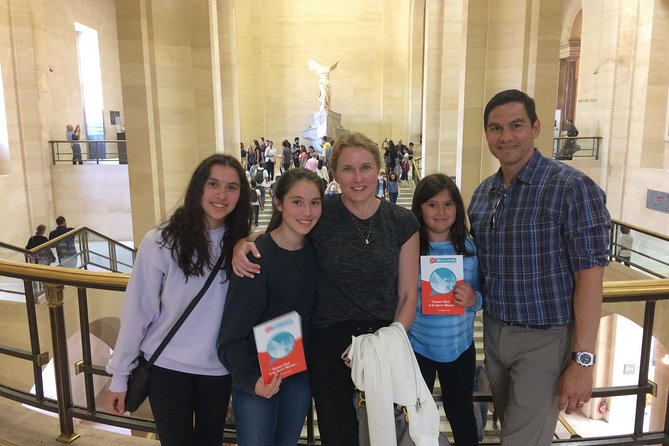
- Children get their own activity booklet: Age-based questions for children ages 3 to 6 or 7 to 12 turn famous artworks into a treasure hunt.
- The route includes three Louvre icons: You’ll see the Venus of Milo, Winged Victory of Samothrace, and Mona Lisa, with explanations designed for children and adults.
- Your guide leads a private group: Only your family takes part, which helps the guide respond to tired children, different ages, or special interests.
- The guides earn especially strong praise: Cindy, Justine, Yaelle, Marcela, Philippe, Marine, Laura, Sean, and others are singled out for patience, warmth, and keeping children involved.
- The tour is short by Louvre standards: About two hours is manageable for most children, but it may feel rushed if you want extensive time at each masterpiece.
- The price covers adult entry, not every possible admission: Children under 18 enter free, but they still must be included in the booking with names and birthdates.
Why a treasure hunt works better than a standard Louvre tour
The Louvre is not a tidy museum with one obvious route. It is a former palace with miles of corridors, grand staircases, packed galleries, and enough famous art to exhaust even an enthusiastic adult. For a child, the question is often not Is this important? but What am I supposed to do here?
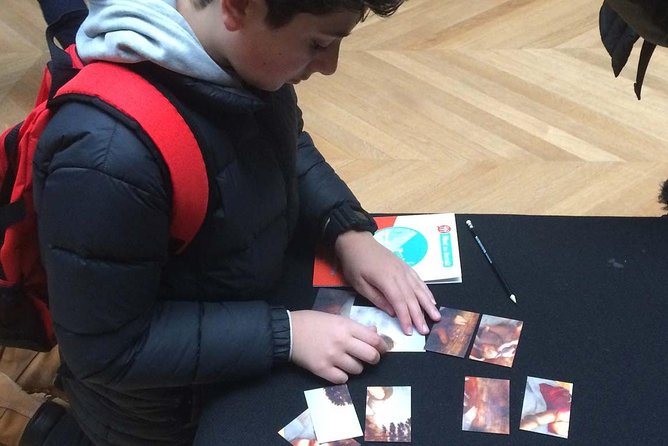
This tour answers that question with a mission. Children receive activity booklets tailored to their age group, then follow clues and questions as the guide takes them from one major work to another. Instead of standing silently in front of a painting, your child may be looking for a detail, thinking about a character’s expression, or trying to solve a mystery.
I like this approach because it gives children a job. The adults still get art and museum context, but the young people are not simply tagging along behind a guide. Several families found that children stayed involved for the full visit, including children as young as five and groups with ages ranging from 6 to 14.
The booklet also goes home with each child. That is a small touch, but it gives the visit a life beyond the museum. A child who keeps the booklet may remember the Louvre as a place where they solved clues, not just a giant building where adults talked.
More Louvre visits and skip-the-line options:
- Paris: Louvre Museum Timed-Entrance Ticket
★ 4.6 · 71,977 reviews - Paris: Louvre Guided Tour with Reserved Access & Boat Cruise
★ 4.3 · 16,353 reviews - Louvre Museum Masterpieces Guided Tour with Access
★ 4.5 · 12,023 reviews
Meeting your guide at the Carrousel du Louvre
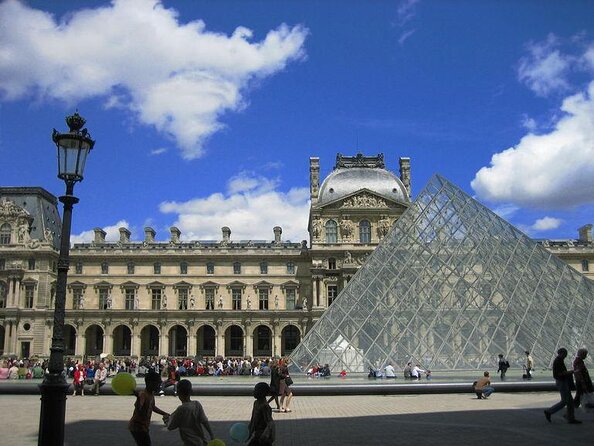
The tour begins at 8 Place du Carrousel, near the Louvre Museum. You make your own way there, and your private guide waits at the meeting point before leading your family inside.
This location is useful because it puts you close to the museum’s main area, but you should still allow time to arrive without rushing. The Louvre is large, and a family carrying bags, managing a stroller, or moving at a child’s pace can lose minutes quickly.
A mobile ticket is provided, and the tour is offered in English. The experience is private, so your group does not share the guide with strangers. That matters more than it might sound. A guide can pause for one child’s question, simplify an explanation, or keep moving if someone is tired, without trying to satisfy a large mixed group.
The practical conditions are straightforward. Public transportation is nearby, but getting to and from the attraction is your responsibility. Food, snacks, and alcoholic drinks are not included. Bus tickets used during the tour are included, if they are needed.
The Louvre Palace becomes part of the game
The first lesson is not just about paintings. The children also learn that they are inside the Louvre Palace, a building with its own story and visual drama.
That is a smart choice. A child who is not yet interested in painting may still care about palaces, kings, hidden clues, grand rooms, or the idea of being a detective. The guide uses the building and its setting to create a sense of discovery before moving on to individual masterpieces.
The activity questions are adjusted for two age ranges, 3 to 6 and 7 to 12. That does not mean every child in a mixed-age family receives a completely separate tour, but it does give the guide material suited to younger and older children.
Families with several ages should find the private setup helpful. One group included children aged 5, 8, and 11, while another included children aged 6, 10, 12, and 14. The older children may want more detail, while younger ones need movement and simple tasks. The guide has room to balance those needs.
Venus of Milo: mythology with a visual clue
The Venus of Milo is one of the Louvre’s signature works, and it makes a good treasure-hunt stop because children can look closely at the statue instead of hearing only a name and date.
The guide asks children to observe and think. What is the figure doing? What might the missing arms have held? How does the pose affect the way you read the statue? The exact questions can vary, but the method is clear: look first, then form an idea.
Mythology is also a useful bridge for young visitors. One family particularly enjoyed a guide’s explanation of Greek mythology, while another praised the way the tour connected art to stories. Children often respond more quickly to gods, heroes, and mysteries than to formal art vocabulary.
Adults get something here, too. The guide’s role is not merely to supervise a scavenger hunt. The best parts of the tour add context about the artwork and the museum while keeping the explanation light enough for children. Reports about guides such as Jessica, Marine, Marcela, and Philippe describe this balance as a major strength.
More Museum Tours in Paris:
- Paris: Louvre Museum Entry Ticket With Host and River Cruise
★ 4.6 · 9,926 reviews - Les Invalides: Napoleon’s Tomb & Army Museum Entry
★ 4.6 · 9,185 reviews - Louvre Museum – Exclusive Guided Tour (Entry Included)
★ 5.0 · 6,296 reviews - Paris: Louvre Museum Hosted Entry and Mona Lisa Audioguide
★ 4.6 · 5,235 reviews
Winged Victory of Samothrace: a dramatic stop for restless children

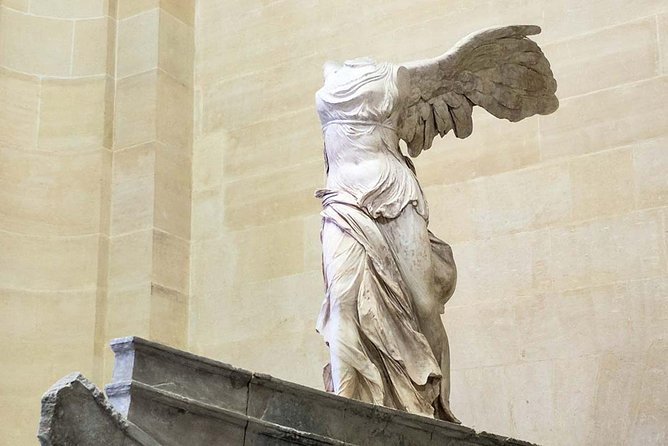
Winged Victory is one of the Louvre’s most theatrical sights. Set high on the Daru staircase, the statue makes a strong impression before anyone explains it. The sweeping folds of fabric, missing head and arms, and sense of forward motion give children plenty to inspect.
This is a particularly good stop for a family tour because it invites questions. Why is the statue missing parts? Why does the clothing look as if wind is pushing against it? Why was it placed where it can be seen from below?
A child does not need a long lecture to enjoy this work. A few well-chosen prompts can turn the statue into a puzzle. You may find that children who have been losing interest in smaller objects become alert again when faced with something so grand.
The route between highlights is also important. The Louvre can feel confusing, especially on a first visit. A guide who knows how to move directly between major works saves you from spending half your museum time checking signs and maps. That is one of the clearest practical benefits of booking this experience.
Mona Lisa: excitement, crowds, and a useful reality check

Most children already know that the Mona Lisa is the Louvre’s most famous painting. Seeing it in person can be exciting, but the room can also be crowded and the viewing area busy.
The treasure hunt gives your child something specific to notice. Why does Mona Lisa smile? What do you see in her expression? How does the background affect the portrait? Questions like these make a short viewing more meaningful than simply taking a photograph and moving on.
You should keep expectations realistic. This is not a quiet, private look at the painting. The guide can help your family understand what you are seeing, but the amount of time you spend at the artwork may depend on crowd conditions and the flow of the museum.
For many children, the Mona Lisa is still the moment they remember most. One family specifically enjoyed the children’s excitement at seeing it, while other families appreciated that the guide added substance beyond the famous name.
Napoleon’s coronation and the mystery in a painting

The tour also uses questions about Napoleon’s coronation to show children how a painting can contain clues. Large historical paintings are often intimidating to younger visitors, but asking what is happening, who is important, and why certain people are placed where they are can make the scene easier to read.
This is where a strong guide makes a difference. A good explanation does not drown children in dates. It helps them notice gestures, clothing, scale, and the way the painter directs attention.
The adult members of your group are not left out. Families with seniors, parents, an 8-year-old, and a 13-year-old found that the guide could entertain different generations at once. That is a useful sign for families who want a children’s activity without feeling they have booked a tour only for toddlers.
Guides who know how to hold a child’s attention
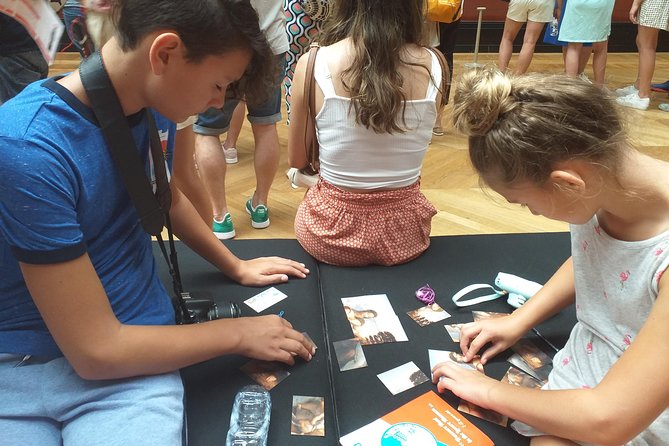
The strongest part of this experience is the guide. The tour company assigns an art historian who works with children, and the individual guides receive unusually warm praise.
Cindy is repeatedly praised for patience, kindness, and clear explanations. One family said she held the attention of children aged 11, 8, and 5 despite jet lag and the many distractions inside the Louvre. She even showed the children how women danced during the Renaissance, a playful detail that helped bring the period to life.
Justine was praised for keeping 7- and 10-year-olds involved, and she added a small puzzle and key-chain souvenir. Yaelle was described as engaging with both children and adults. Laura worked well with 9-year-olds, while Laurine held a 5-year-old’s attention for the full two hours.
Other praised guides include Marcela, Philippe, Marine, Tetiana, Sean, Jessica, and Quintin. Their strengths vary, but the pattern is consistent: warmth, patience, art knowledge, and an ability to adjust the presentation for children.
That does not guarantee that every guide will match your family perfectly. Children tire, and a guide cannot control a crowded gallery or a delayed start. Still, the private format gives the guide the best possible chance to respond to your group.
Is two hours the right amount of time?
For most families, yes. Two hours is long enough to see major highlights and short enough to avoid turning the Louvre into an endurance test.
Several families found that the time passed quickly and that the children stayed active through the visit. The activity booklet helps create momentum, and the focus on selected masterpieces prevents the tour from becoming a long march through random rooms.
The drawback is that two hours may not feel like two full hours of museum time. One family reported an approximately 80-minute visit and felt rushed, although they still enjoyed the experience. You should also remember that moving through security, stopping for questions, and accommodating children can affect the pace.
If you want to see many lesser-known galleries, spend a long time studying individual paintings, or continue exploring every wing afterward, this tour may feel too limited. If you want a successful first introduction for children, the short format is one of its selling points.
What the $760.28 price really buys you
The price is $760.28 per group of up to four people, not per person. The stated family rate is based on two adults and two children.
That is expensive for a two-hour activity. The value comes from the private guide, the planned route, the children’s booklets, and the included adult admission tickets. You are paying for structure and attention, not simply entry to the museum.
Adult Louvre tickets worth €32 each are included. Admission is free for visitors under 18 and for EEA residents under 26 who show valid identification and proof of residency. Even when a child’s ticket is free, you still need to include every participant in the booking and provide children’s names and birthdates in advance.
For a family of four who would otherwise struggle to organize a Louvre visit, the price can make sense. You avoid wandering, reduce the chance of losing children’s interest, and get a guide focused only on your group. For a larger family, the price may look better per person, but the listed price specifically applies to a group of up to four, so check the booking terms for your party size.
The experience receives a 4.9 rating from 78 reviews, with 97 percent recommending it. Those figures support the idea that the tour delivers what it promises, but they do not erase the cost or the possibility of a shorter-than-expected visit.
Family logistics and small cautions
The tour requires a moderate level of physical fitness. You should expect walking through a large museum and moving between galleries, though one family described the amount of walking as manageable for 8- and 10-year-olds.
Strollers deserve special attention. One family encountered a problem when a stroller could not use an elevator because it was out of service, and museum security would not allow the stroller to proceed. In the end, one adult stayed outside with the baby while the rest of the group continued.
That incident was not caused by the guide, and the family remained very pleased with Cindy. Still, it is a useful warning if you are visiting with a baby or stroller. Check the current museum access arrangements before you go, and be ready for the possibility that a broken lift or security rule could affect your plans.
The tour ends back at the meeting point. Plan your next activity with some flexibility, especially if your children need a snack or rest afterward.
Who should book this Louvre experience?
I would choose this tour for a first Louvre visit with children, especially ages 5 to 12. It is also a good fit for families with mixed ages, since the guide can speak to younger children while still giving adults useful art and museum context.
It suits you if you want to see the major icons without navigating the Louvre alone. It also suits families whose children resist museums but respond well to puzzles, stories, and small missions.
I would think twice if your main goal is serious art study, a slower look at a particular collection, or a full day inside the museum. The treasure hunt is designed to make the Louvre approachable, not to cover everything.
The private format is a real advantage for a tired child, a nervous first-time museum visitor, or a family that needs a flexible pace. The guides have been praised for exactly those moments, including jet lag, birthday visits, mixed ages, and children who began the tour already tired.
Should you book the Louvre family treasure hunt?
Book it if you want your children to leave the Louvre talking about clues, mythology, statues, and Mona Lisa’s smile instead of asking when they can go. The activity booklet, focused route, and warm child-friendly guides give this immense museum a manageable shape.
Skip it if $760.28 feels too high for two hours or if you want to set your own long, detailed route. Also allow for some uncertainty around timing and museum access, particularly with a stroller.
For families seeking a structured first visit, I think the private treasure hunt is one of the more sensible ways to introduce children to the Louvre. Just arrive prepared for walking, include every child in the booking, and treat the two-hour plan as a lively highlights visit rather than a complete museum tour.
FAQ
How long does the Louvre family treasure hunt last?
The experience is scheduled for approximately two hours. One family reported a visit of about 80 minutes, so the actual timing may vary.
Where does the tour start?
The meeting point is 8 Place du Carrousel, 75001 Paris, France, by the Louvre Museum.
Where does the tour end?
The activity ends back at the meeting point.
Is the Louvre admission ticket included?
Timed-entry tickets worth €32 for adults are included. Admission is free for visitors under 18 and EEA residents under 26 who provide valid identification and proof of residency.
Do children need to be included in the booking if admission is free?
Yes. Every participant must be included, and children’s names and birthdates must be provided in advance.
What ages are the activity booklets designed for?
The questions and explanations are created for two age levels: children ages 3 to 6 and children ages 7 to 12.
Can I cancel for a full refund?
Yes. You can cancel at least 24 hours before the experience start time for a full refund. Cancellations or changes made less than 24 hours before the start time are not accepted for a refund.
Recently added around Paris
- 2 hour outdoor group activity in Paris: SAINT GERMAIN★ 5.0 · 48 reviews
- Private Half-Day Guided Tour of Paris★ 4.5 · 48 reviews
- Paris Dinner Show Opera Bel Canto★ 4.5 · 48 reviews
- Paris Vintage Tour by Night on a Sidecar with Champagne★ 5.0 · 48 reviews
- Secrets & Scandals of the Louvre – Limited to 6 Guests★ 5.0 · 48 reviews
- Paris Photoshoot: Eiffel Tower Exclusive Private Experience★ 5.0 · 48 reviews
- Paris: Louvre Mona Lisa Discovery Guided Tour with Ticket★ 4.9 · 48 reviews
- From Paris: Versailles Full-Day Guided Tour with Lunch★ 4.9 · 48 reviews
Louvre Museum Tours, compared.


Paris: Louvre Guided Tour with Reserved Access & Boat Cruise
Read our review →
Louvre Museum Masterpieces Guided Tour with Access
Read our review →
Paris: Louvre Museum Entry Ticket With Host and River Cruise
Read our review →
Paris: Priority Access Louvre with Host -Direct to Mona Lisa
Read our review →
Mona Lisa & Louvre Masterpieces Tour with Reserved Access
Read our review →
Louvre Museum – Exclusive Guided Tour (Entry Included)
Read our review →
Paris: Louvre Reserved Ticket and River Cruise Combo
Read our review →Browse the lists this tour appears in