
Reviewed · MONTMARTRE & SACRé-CœUR TOURS
Paris: Small Group Moulin Rouge &Sacré Cœur Montmartre Tour
Montmartre tells Paris’s wildest stories. This two-hour walking tour links the Moulin Rouge, Amélie locations, artists’ hangouts, Dalida landmarks, and Sacré-Cœur in one compact route. I like the small group capped at 15 and the strong personal touch offered by guides such as Selda, Alice, Danyel, and Daniel. The main catch is simple: this is an uphill walk with stairs, crowds, and no Moulin Rouge show included.
I also like the range of stops. You get film history, cabaret, painting, music, religion, and village-like streets rather than only a quick climb to the basilica. At $59.28 per person, the price is fair if you want stories and orientation, but less attractive if you prefer to wander Montmartre alone and read plaques at your own pace.
In This Review
- What makes this Montmartre walk worth your time
- From the Moulin Rouge into Montmartre
- Café des Deux Moulins and the Amélie connection
- Moulin de la Galette and Montmartre’s artists
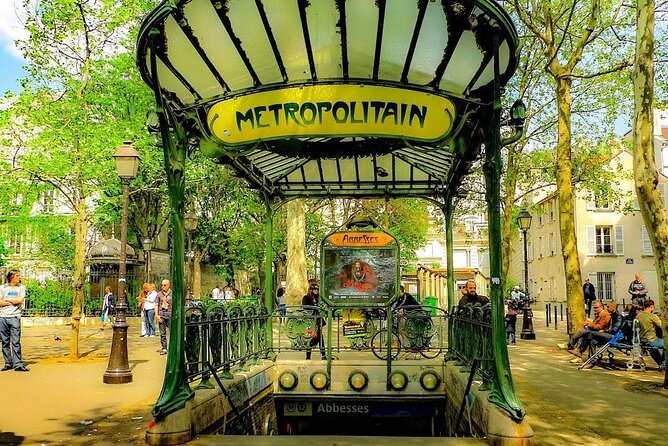
- Place des Abbesses and the Wall of Love
- Bateau-Lavoir and the early twentieth-century art scene
- Dalida’s home, statue, and place in Montmartre
- La Maison Rose and the Montmartre vineyard
- La Bonne Franquette and the old café culture
- Sacré-Cœur and the payoff at the top
- What the two-hour timing really means
- The guides make the biggest difference
- Is $59.28 a fair price?
- Who should book this walk?
- Should you book the Moulin Rouge and Sacré-Cœur tour?
- FAQ
- How much does the tour cost?
- How long does the Montmartre tour last?
- Where does the tour begin?
- Where does the tour end?
- Is the Moulin Rouge show included?
- Is admission to the listed Montmartre stops included?
- How large is the tour group?
- Is the tour offered in English?
- Can I cancel for a full refund?
What makes this Montmartre walk worth your time
- Moulin Rouge to Sacré-Cœur in one route: You begin near Place Blanche and finish high on the Montmartre hill, covering several major sights without planning the route yourself.
- A maximum of 15 people: The small format makes it easier to hear the guide and ask questions, though busy streets can still create noise.
- Film and music landmarks: Café des Deux Moulins, Dalida’s former home, and her statue add a personal feel to the neighborhood.
- A useful mix of art and local history: Picasso, Modigliani, Renoir, Van Gogh, Toulouse-Lautrec, Saint Denis, and the Montmartre vineyard all enter the story.
- A scenic finish at Sacré-Cœur: The basilica provides architecture and broad views over Paris.
- A clear fitness warning: The walk includes uphill sections and stairs, so comfortable shoes and a steady pace matter.
From the Moulin Rouge into Montmartre

The meeting point is 5 Place Blanche, an easy place to reach by public transport. It puts you beside the Moulin Rouge, where the tour begins with about 10 minutes on the story of the famous cabaret.
This is an exterior visit. The Moulin Rouge admission ticket is not included, and the tour does not include a cabaret performance. That distinction matters because the title can sound like a show package. Think of this stop as an introduction to the building, its place in Parisian entertainment, and the district around it.
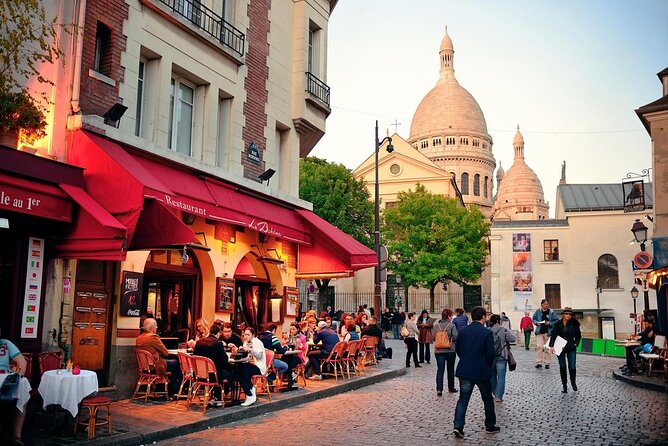
From there, the route moves uphill into Montmartre. The neighborhood changes quickly. The bright signs and nightlife around Place Blanche give way to narrower streets, cafés, old houses, artists’ addresses, and open views. A guide helps connect those scenes, which is the real value of this walk.
More Montmartre and Sacré-Cœur walks:
- Montmartre Hidden Gems and Scenic Highlights Walking Tour
★ 5.0 · 2,684 reviews - Montmartre Hill French Gourmet Food and Wine Tasting Walking Tour
★ 5.0 · 2,588 reviews - Paris: Montmartre Cheese, Wine & Pastry Guided Walking Tour
★ 4.8 · 2,255 reviews
Café des Deux Moulins and the Amélie connection
The five-minute stop at Café des Deux Moulins is brief but memorable for film fans. This is the café used in Amélie, including the spot associated with Amélie’s work.
You should not expect a long café visit or a meal as part of the tour. Admission is free, but food and drinks are not listed as included. The stop works best as a quick look and photo opportunity, followed by the guide’s explanation of how the film helped shape Montmartre’s modern image.
If Amélie is important to your Paris plans, this visit gives you a useful anchor. If you have not seen the film, the stop still fits the route, though it may not carry the same emotional weight.
Moulin de la Galette and Montmartre’s artists
Le Moulin de la Galette receives about five minutes. Its windmill is closely tied to Montmartre’s bohemian past and was painted by Renoir and other artists.
This is one of those stops where a guide adds more than a photograph. The windmill helps explain why artists were drawn to Montmartre, when the hill still felt apart from central Paris. You get a glimpse of the old village atmosphere that remains one of the area’s main charms.
The time is short, so you will not study paintings or enter a museum here. Still, the stop gives the rest of the walk a useful frame. Montmartre is not only a pretty collection of streets. It was a place where artists lived, worked, met, and built reputations.
Place des Abbesses and the Wall of Love
At Place des Abbesses, the guide introduces the story of Saint Denis, described as the first bishop of Paris, along with his dramatic martyrdom. You also hear about the Red Abbess and the local church, which differs from many other Paris churches.
The listed stop lasts about 10 minutes. This is a good moment to listen closely, since the story adds a darker edge to the neighborhood’s cheerful cafés and postcard views. Montmartre’s past is not all romance and painting.
Next comes Le Mur des Je t’aime, the Wall of Love. The phrase I love you appears in many languages on this artistic landmark, making it a popular place for photographs. The stop takes about 10 minutes.
The Wall of Love is easy to understand and quick to visit. It is not a major historical monument, but it offers a lighter pause between the religious story of Saint Denis and the art history still ahead.
More Moulin Rouge and cabaret nights:
- Paris: Moulin Rouge Cabaret Show Ticket with Champagne
★ 4.7 · 16,088 reviews - Paris: Dinner Show at the Moulin Rouge
★ 4.8 · 3,333 reviews - Seine Dinner Cruise, Eiffel Tower Access and Moulin Rouge Show
★ 4.0 · 2,310 reviews - Paris Moulin Rouge Cabaret Show and Dinner
★ 4.5 · 1,772 reviews
Bateau-Lavoir and the early twentieth-century art scene
Le Bateau-Lavoir is one of the most worthwhile stops for anyone interested in modern art. This former artists’ residence was linked with Pablo Picasso and Amedeo Modigliani, and the guide uses the address to explain the early twentieth-century art scene in Montmartre.
The stop lasts around 15 minutes, longer than several of the photo stops. That extra time makes sense. A building associated with major artists can seem ordinary from the street, so the stories are what give it meaning.
I would pay particular attention here if you want more than a checklist of famous addresses. The guide’s narrative approach is often praised, and several guides have been described as funny, warm, and easy to understand. That style matters at places like Bateau-Lavoir, where the physical view alone does not tell you much.
Dalida’s home, statue, and place in Montmartre
The route then turns to singer Dalida, a major figure in Montmartre. You visit her former home for about 10 minutes and stop at her statue for another 10 minutes.
Together, these stops provide a change from painters and writers. You see how the neighborhood’s cultural identity continued into modern French popular music. Dalida’s connection with Montmartre is not treated as a passing celebrity detail. Her home and statue show how strongly she remains linked with local memory.
The bust is also a favorite photo stop. A guide can give context about Dalida’s life and influence, while the statue gives you a clear, physical marker in the neighborhood. If you know her music, this section may be a highlight. If you do not, it still broadens the tour beyond the usual Picasso and Van Gogh story.
La Maison Rose and the Montmartre vineyard
La Maison Rose is one of Montmartre’s most recognizable sights. The pink house has appeared in countless photographs and attracts people for its color, shape, and connection with the artistic side of the district.
The stop lasts about 10 minutes, enough for pictures and a short explanation. Expect crowds around popular photo spots, especially when the streets are busy. One guide, Danyel, has been praised for taking good pictures at memorable locations, which can be useful if you want a family or group photo without handing your phone to a stranger.
The five-minute stop at Vigne du Clos Montmartre offers a different view of the hill. The local vineyard produces wine and reflects the area’s older connection with winemaking. It is a small detail, but it helps Montmartre feel like a village within Paris rather than only an entertainment district.
Do not expect a wine tasting. The tour presents the vineyard as a place of local history and community meaning, not as a separate tasting experience.
La Bonne Franquette and the old café culture
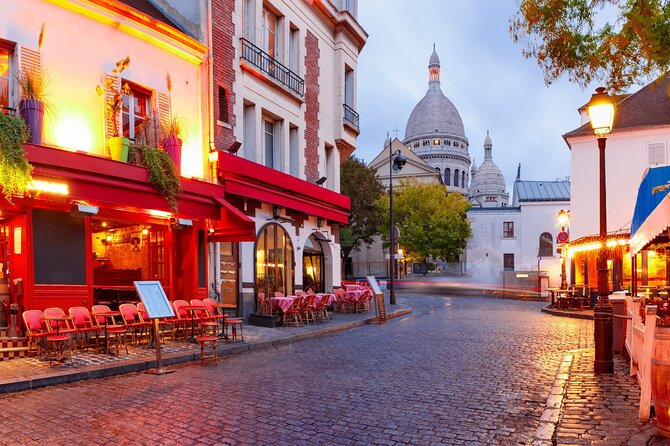
La Bonne Franquette is a historic café associated with artists such as Van Gogh and Toulouse-Lautrec. The stop lasts around 10 minutes and adds a strong café-culture note to the walk.
This is a useful contrast with Café des Deux Moulins. The earlier stop is tied to cinema, while La Bonne Franquette points toward the real artists and writers who helped build Montmartre’s reputation. You see how cafés served as meeting places, workplaces, and informal studios.
Again, the scheduled visit is not a meal. If you want to eat or order a drink, plan that separately. The tour’s purpose is to show you the setting and explain its place in the neighborhood.
Sacré-Cœur and the payoff at the top
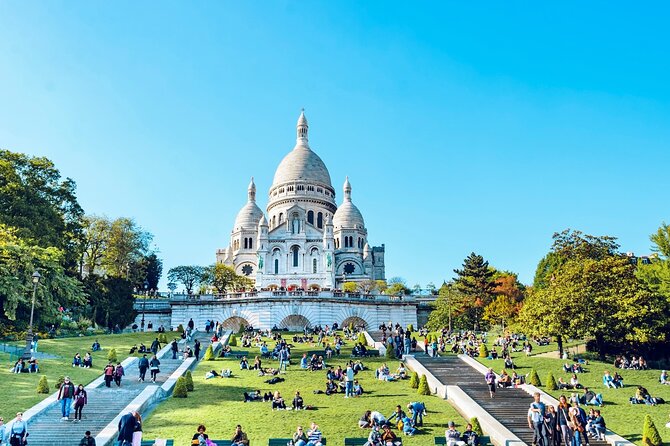
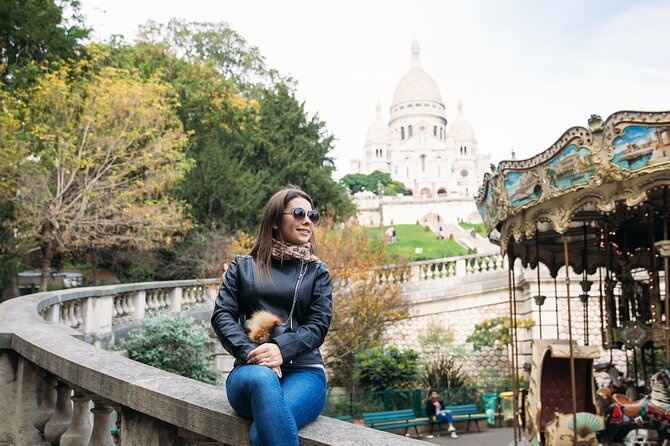
The final stop is the Basilique du Sacré-Cœur de Montmartre, with about 15 minutes to admire the basilica and take in the view across Paris. The route ends at 35 Rue du Chevalier de la Barre, not back at Place Blanche.
That separate ending is important. You will need to find your own way onward after the tour, so check your next destination before you arrive. The end point is near the basilica, but your transport plan will differ depending on where you are staying.
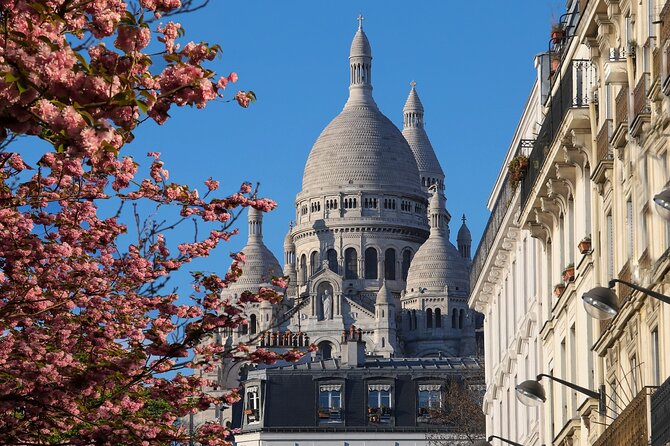
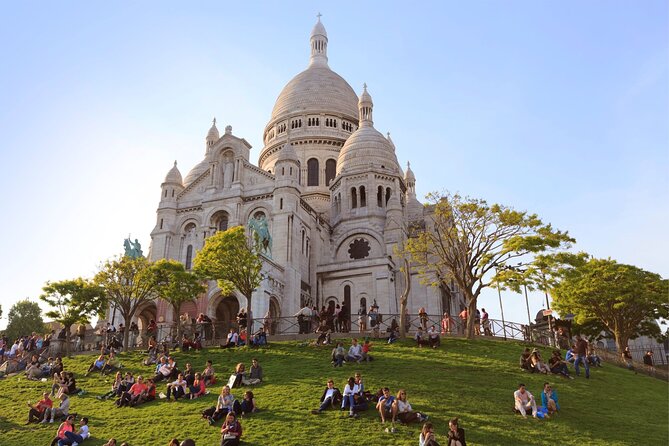
Sacré-Cœur is the natural finish because the walk has been climbing toward it. The basilica’s white exterior and hilltop position make it one of Paris’s most recognizable sights, while the view gives you a broad sense of the city’s size and layout.
The uphill route is broken into many short stops, which helps. Still, it is not a flat stroll. One account describes much of the walk as uphill, with stairs and regular opportunities to pause. Wear shoes with good support and allow extra energy for the final section.
What the two-hour timing really means
The listed stop times add up to roughly 115 minutes, leaving only a small amount of time for walking between locations, gathering the group, and handling street crowds. The schedule is therefore purposeful and fairly brisk.
You will see many places, but you will not linger at each one. Most stops last between five and 15 minutes. That format suits you if you want a guided introduction and a list of places to revisit later. It is less suitable if you want long café breaks, extended photography, or museum-style discussion at every address.
A small group helps the timing. With a maximum of 15 people, the guide can usually keep the walk moving without the delays of a large coach group. Several guides have also been praised for adjusting the pace, including Daniel, who noticed when people needed to sit and rest, and Danyel, who adapted the walk when the group was especially small.
One practical weakness is sound. In crowded areas, it can be hard to hear a guide without an audio system. A past visitor specifically wished for headphones, a fair point in busy Montmartre. Stay close to the guide, especially around popular squares and narrow streets.
The guides make the biggest difference
The strongest part of this experience is the guiding. Selda is described as warm, funny, engaging, and able to keep a family interested on a cold day. Alice receives praise for her clear English, friendly manner, and strong local storytelling. Danyel and Daniel are both praised for patience, photographs, and thoughtful pacing.
Names and guide assignments can change, so you should not book on the promise of one particular person unless the provider confirms it. Still, the repeated pattern is encouraging: the guides bring personal energy, explain history in a conversational way, and help the neighborhood feel less like a set of tourist stops.
The overall score is 4.9 from 152 ratings, with 97 percent recommending the experience. That is a strong record, though it is not a guarantee of a perfect day. One serious complaint describes a same-day cancellation attempt and a refund still pending. The published policy allows free cancellation up to 24 hours before the start time, while cancellations within 24 hours are not refunded. Poor weather can lead to a new date or a full refund.
Is $59.28 a fair price?
At $59.28 per person, you are paying mainly for the guide, the route, and the time saved in planning. The included sights are public locations, and there are no major admission tickets included. The Moulin Rouge show is specifically excluded, while the other listed stops are free to visit.
For a first visit to Montmartre, I think the price can be good value. You cover a large section of the hill in two hours and get context for places that are easy to pass without understanding. The small group also gives you a better chance to ask questions than a large sightseeing walk.
The value drops if you already know Montmartre well or prefer independent wandering. You could visit many of these places without paying, though you would need to research the route and stories yourself. I would compare the cost with the price of a private guide, but this small-group option offers a middle ground between going alone and booking a fully private tour.
Who should book this walk?
I would recommend it for a first-time visitor who wants to understand Montmartre quickly. It also suits film fans, art lovers, families, and anyone who wants a guide to handle the route while they focus on the sights.
It is a good choice for you if:
- You want an English-speaking guide.
- You enjoy history told through stories and people.
- You like small groups rather than large sightseeing crowds.
- You want Sacré-Cœur and the Moulin Rouge connected in one outing.
- You can manage uphill walking and stairs.
- You want photo stops at La Maison Rose, the Wall of Love, and Dalida’s statue.
I would think twice if you have limited mobility, dislike hills, or want to attend a Moulin Rouge performance. The tour does not include the show, and the route involves enough climbing to affect how comfortable you feel.
Should you book the Moulin Rouge and Sacré-Cœur tour?
Book it if you want a lively, story-driven introduction to Montmartre rather than a simple basilica visit. The best reasons are the compact route, the small group, the mix of art, film, music, religion, and the consistently strong guiding from names such as Selda, Alice, Danyel, and Daniel.
Skip it if you want a slow morning, a flat route, or a Moulin Rouge cabaret ticket. For most first visits, though, $59.28 is a reasonable trade for two hours of orientation in one of Paris’s most characterful neighborhoods. Bring good shoes, keep close enough to hear the guide, and remember that the tour ends at Sacré-Cœur rather than where it began.
FAQ
How much does the tour cost?
The tour costs $59.28 per person.
How long does the Montmartre tour last?
The experience lasts approximately two hours.
Where does the tour begin?
It begins at 5 Place Blanche, 75009 Paris, France.
Where does the tour end?
It ends at 35 Rue du Chevalier de la Barre, 75018 Paris, France, near the Basilique du Sacré-Cœur de Montmartre.
Is the Moulin Rouge show included?
No. The Moulin Rouge show and admission are not included.
Is admission to the listed Montmartre stops included?
The listed stops other than the Moulin Rouge are shown as free admission. The guide is included.
How large is the tour group?
The tour has a maximum of 15 people.
Is the tour offered in English?
Yes. The tour is offered in English.
Can I cancel for a full refund?
Yes, if you cancel at least 24 hours before the experience start time. Cancellations within 24 hours are not refunded. If poor weather causes the provider to cancel, you are offered another date or a full refund.
Recently added around Paris
- Private Half-Day Guided Tour of Paris★ 4.5 · 48 reviews
- 2 hour outdoor group activity in Paris: SAINT GERMAIN★ 5.0 · 48 reviews
- Paris Dinner Show Opera Bel Canto★ 4.5 · 48 reviews
- Paris Vintage Tour by Night on a Sidecar with Champagne★ 5.0 · 48 reviews
- Secrets & Scandals of the Louvre – Limited to 6 Guests★ 5.0 · 48 reviews
- Paris Photoshoot: Eiffel Tower Exclusive Private Experience★ 5.0 · 48 reviews
- Paris: Louvre Mona Lisa Discovery Guided Tour with Ticket★ 4.9 · 48 reviews
- From Paris: Versailles Full-Day Guided Tour with Lunch★ 4.9 · 48 reviews
Montmartre & Sacré-Cœur Tours, compared.
Montmartre Hidden Gems and Scenic Highlights Walking Tour
Read our review →
Montmartre Hill French Gourmet Food and Wine Tasting Walking Tour
Read our review →
Paris: Montmartre Cheese, Wine & Pastry Guided Walking Tour
Read our review →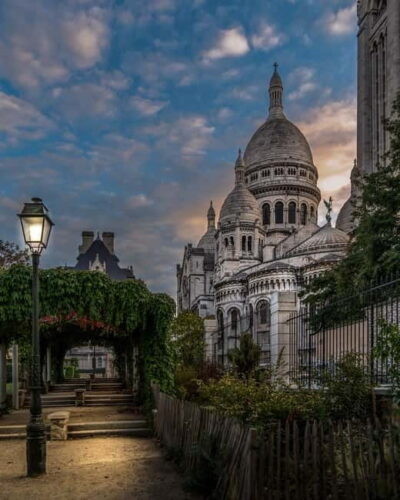
Paris: Montmartre Highlights Walking Tour with a Local Guide
Read our review →
Paris: Sacré-Coeur and Montmartre Tour with Expert Guide
Read our review →
Private Montmartre Food Tour with Wine, Cheese & Pastries
Read our review →
Paris Montmartre Food Tour – A Full French Meal by Do Eat Better
Read our review →
Hidden Montmartre: Paris’ Secret Streets Walking Tour
Read our review →Browse the lists this tour appears in