
Reviewed · NORMANDY TOURS
DDay American Beaches and US Airborne Full Day Tour from Bayeux
History comes sharply into focus here. This 8.5-hour tour from Bayeux links Omaha Beach, Utah Beach, Pointe du Hoc, Sainte-Mère-Église, Angoville-au-Plain, and the Normandy American Cemetery in one carefully planned day. I like the small group of no more than seven and the way guides such as Sophie, Chloe, Yannick, Gwen, Corinne, and Mickael use maps, photographs, and personal stories to explain what happened on June 6, 1944.
I also like the comfortable air-conditioned minivan, which saves you from navigating country roads, parking lots, and widely scattered battle sites. The main drawback is the pace: you cover a lot of ground in one day, and two hours at Utah Beach may include lunch, sightseeing, and museum time, so you will not have unlimited time at every location.
In This Review
- Key points at a glance
- Why this Bayeux tour works so well
- Omaha Beach: understanding why the first hours were so costly
- Colleville-sur-Mer: a quiet hour among 9,000 graves
- Pointe du Hoc: craters, cliffs, and the Ranger assault
- Sainte-Mère-Église: the airborne story in a small town
- Utah Beach: a different landing story
- Angoville-au-Plain: a fitting final stop
- The guides make or break the day
- Price, timing, and practical value
- Who should book this experience?
- Should you book the Bayeux D-Day beaches tour?
- FAQ
- Where does the tour begin?
- What time does the tour start?
- Where does the tour end?
- How long does the tour last?
- How many people can join the tour?
- What transportation is included?
- Is lunch included?
- Which D-Day sites are visited?
- Is the tour offered in English?
- Can I cancel for a full refund?
Key points at a glance
- Omaha Beach comes first: You begin at the landing site of the 1st and 29th Infantry Divisions, with time to grasp the German defenses and the danger faced by the first waves.
- The American Cemetery is a solemn centerpiece: One hour among more than 9,000 graves gives the day its emotional weight.
- Pointe du Hoc feels like a battlefield: Craters, bunkers, and dugouts make the Ranger assault easier to picture.
- Sainte-Mère-Église connects the beaches to the airborne assault: The church tower recalls the paratrooper who became caught there during the night.
- Angoville-au-Plain ends the day on a human note: Two medics treated about 80 wounded soldiers, including American and German troops.
- The guides are a major strength: Sophie and Chloe receive repeated praise for clear explanations, visual aids, good pacing, and vivid stories.
Why this Bayeux tour works so well
D-Day sites are spread across Normandy. You can drive yourself, but the military story is not always obvious from the road. A field, church, bunker, or beach can look peaceful now, while the key events took place across several miles and involved complicated movements by sea, air, and land.
This tour gives you a useful framework. You begin with the American landings on the coast, move to the cemetery behind Omaha, then follow the Rangers and airborne troops inland before returning to Utah Beach and a small church aid station. I like that order because it moves from the scale of an invasion to the experiences of individual soldiers.
The group size matters. With a maximum of seven people, you can ask questions without trying to get a guide’s attention from the back of a large coach. Guides use maps and photographs to show the coastline, German positions, landing areas, and troop movements. That visual help is especially useful at Omaha and Pointe du Hoc, where the terrain matters as much as the dates.
The tour begins at 9:00 a.m. at Place du Québec in central Bayeux and returns there at the end. That location is practical if you are staying in town, and one detailed account praised its walkable position near shops, hotels, historic sights, and the Bayeux train station.
More full-day trips from Bayeux:
- Normandy American D-Day Beaches Full Day Tour from Bayeux
★ 5.0 · 2,103 reviews - Omaha and Band Of Brothers Full Day Tour
★ 5.0 · 1,104 reviews - From Bayeux: American D-Day Sites in Normandy Full-Day Tour
★ 4.9 · 503 reviews
Omaha Beach: understanding why the first hours were so costly
After about a 30-minute drive from Bayeux, you reach Omaha Beach. The visit lasts around 40 minutes, which is enough for an explanation and time to look across the shore, but not enough for a slow, extended exploration.
This is where the 1st and 29th U.S. Infantry Divisions came ashore. Your guide explains the German defenses, the beach layout, and the problems facing the first waves. Maps and photographs help you connect the present-day view with the assault plan.
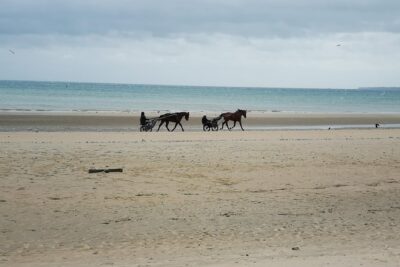
Omaha can be difficult to understand without guidance. The broad sand, open views, and quiet water do not immediately reveal why the landing was so dangerous. The guide’s job here is to show you the exposed approaches and explain how the defenses shaped the battle.
I would pay close attention to the personal accounts. Chloe, Sophie, Yannick, and Gwen are praised for using individual stories of courage, confusion, sacrifice, and loss rather than giving only a list of dates. That approach makes the beach feel less like a military diagram and more like a place where frightened young men had to make decisions under fire.
The short visit is the main limitation. If Omaha is your central interest, you may wish for more time to walk and reflect. Still, it is a strong opening because the guide gives you the essential setting before you visit the cemetery.
Colleville-sur-Mer: a quiet hour among 9,000 graves
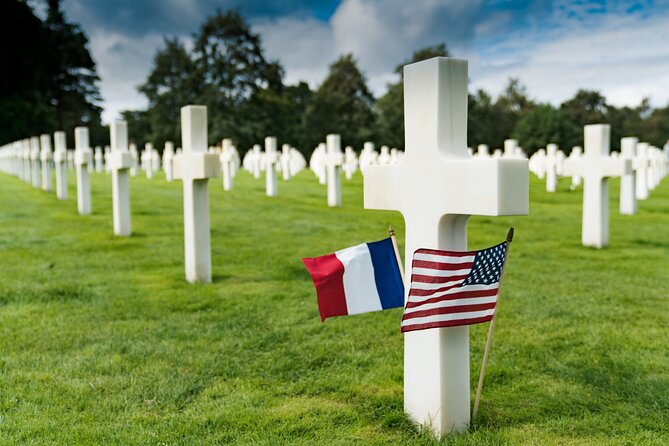
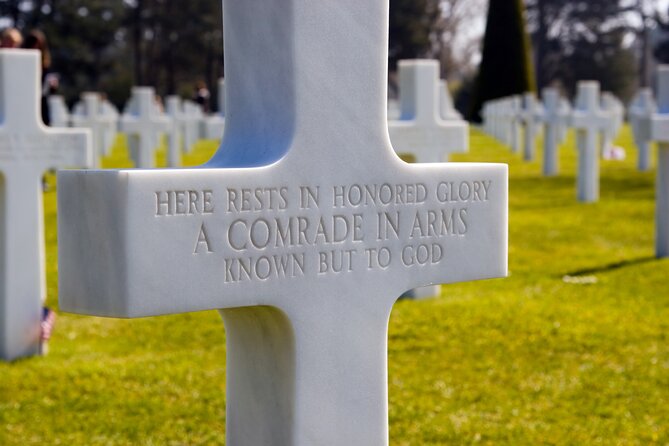
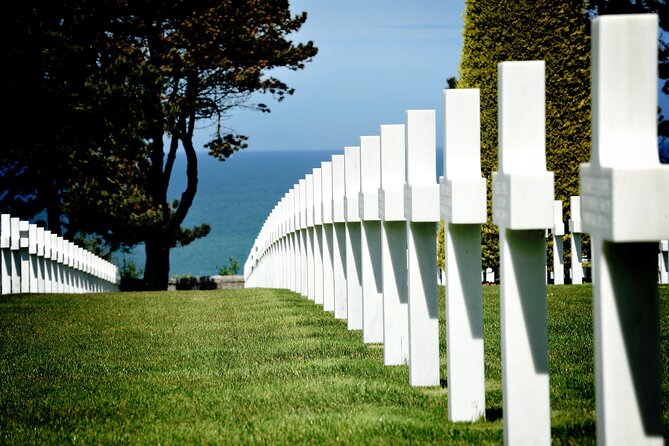
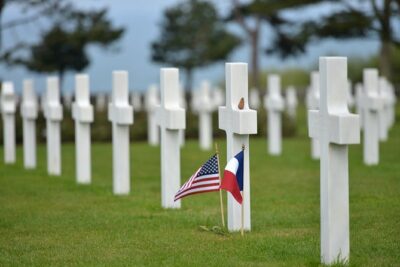
The Normandy American Cemetery at Colleville-sur-Mer lies behind Omaha Beach. The tour allows about one hour here, and that is enough to walk through part of the grounds, view the rows of white markers, and take in the scale of the loss.
More than 9,000 American servicemen and women are buried here. The cemetery is operated by the American Battle Monuments Commission and is free to enter as part of the visit.
This is likely to be the most affecting stop of the day. Several accounts describe it as beautiful, solemn, informative, and emotionally powerful. I would not rush this stop. After the tactical explanation at Omaha, the cemetery gives you time to consider the human cost.
You may want to note the name of a relative before the tour. One person discovered that a family member was buried there, which added a deeply personal element to the visit. The provided information does not promise genealogy assistance, so treat that as a possible discovery rather than a service.
The cemetery is also a useful pause in the schedule. D-Day tours can become a fast stream of beaches, bunkers, and troop movements. Here, the rows of graves create a clear reminder that the operation was paid for in individual lives.
Pointe du Hoc: craters, cliffs, and the Ranger assault
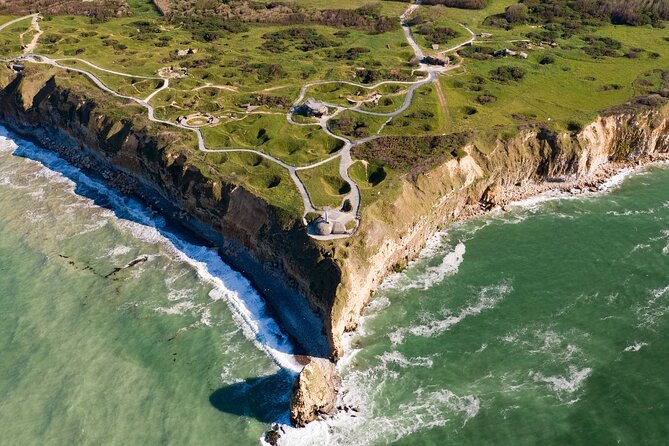
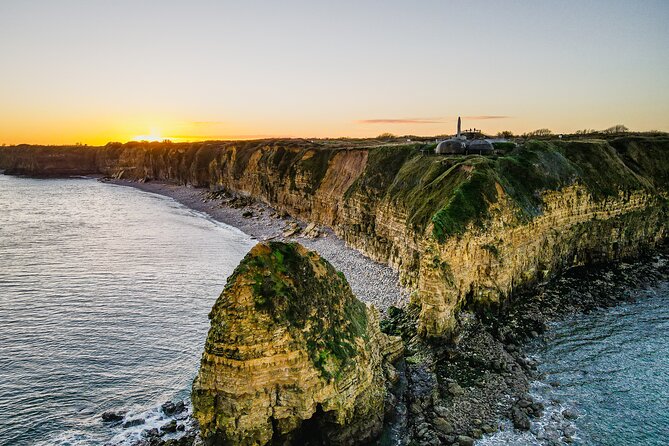
Pointe du Hoc is one of the most visually striking stops. You have about an hour to see the bomb craters, bunkers, and dugouts connected with the assault by the 2nd U.S. Ranger Battalion under Lieutenant Colonel James E. Rudder.
The Rangers scaled the cliffs to destroy a German gun battery that threatened the landing operation. The terrain makes this stop different from Omaha and Utah. At the beaches, you look across open ground. At Pointe du Hoc, the craters and steep edge help you grasp the physical challenge of the attack.
A good guide will tie the site to the wider operation. You should learn why the gun position mattered, what the Rangers were trying to accomplish, and how the ground itself affected the assault. The available descriptions emphasize maps, photographs, and detailed explanations, which are particularly useful here.
Pointe du Hoc is also a place where your shoes matter. The tour data does not specify walking requirements, but the site includes craters, bunkers, and dugouts. Comfortable footwear is a sensible choice, and you should expect uneven ground rather than a polished indoor attraction.
After this stop, the minivan takes about 30 minutes to Sainte-Mère-Église. That drive provides a useful transition from the coastal landings to the airborne operation inland.
A few more Bayeux trips worth weighing up
- Normandy American D-Day Experience – Group tour from Bayeux
★ 5.0 · 1,566 reviews - Normandy Beaches Half-Day Afternoon Trip from Bayeux (A2)
★ 4.5 · 1,116 reviews - Omaha Beach D-Day Experience – Afternoon group tour from Bayeux
★ 5.0 · 1,088 reviews - Omaha and Utah beaches
★ 5.0 · 1,085 reviews
Sainte-Mère-Église: the airborne story in a small town
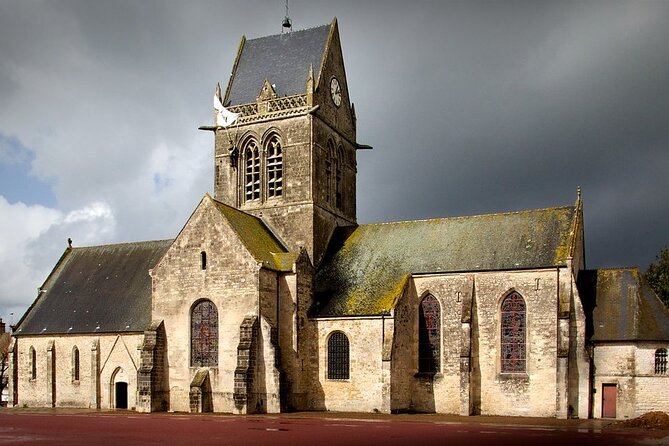
Sainte-Mère-Église was the first town captured by American paratroopers. The church tower is associated with the well-known story of a paratrooper who became caught there during the night.
The tour allows around two hours in town, making this one of the less hurried parts of the day. Your guide explains the airborne operation and shares stories about the men involved. The longer pause also gives you room for lunch and personal exploration.
Several accounts praise the Airborne Museum in Sainte-Mère-Église. The tour information identifies the town as a stop but does not separately spell out museum admission, so check the current arrangements if the museum is a priority for you. The generous time block should help, but the exact balance between the town, lunch, and museum depends on the day’s schedule.
I like this stop because it changes the rhythm of the tour. You are not looking only at a beach or memorial. You are walking through a living town connected to the night parachute drops and the struggle to secure the area.
If you have a particular interest in the airborne campaign, use your question time here. The guide can connect the church, the town, and the wider operation in a way that is hard to gain from a quick independent visit.
Utah Beach: a different landing story
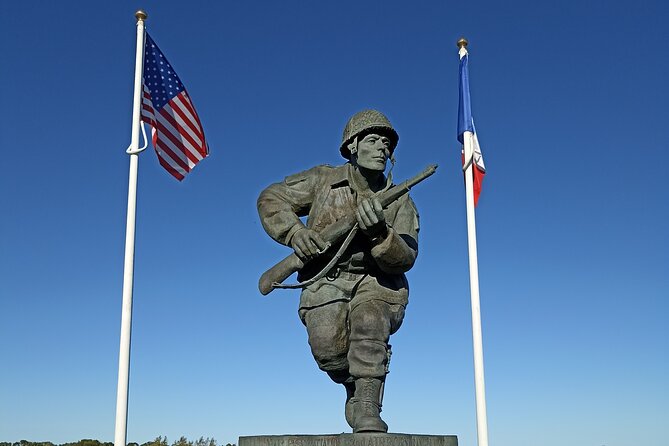
From Sainte-Mère-Église, the drive to Utah Beach takes about 20 minutes. The tour gives you roughly two hours here, the longest scheduled stop.
Utah was the landing area for the 4th Infantry Division. Your guide explains how American troops breached the German defenses and highlights Brigadier General Theodore Roosevelt Jr., who led the first wave and landed at about 6:30 a.m. He later received the Medal of Honor.
The additional time gives you more flexibility than at Omaha. You may have room for lunch, a museum visit, or a longer look at the beach, although the precise plan is not stated. Bring money for lunch because it is not included in the tour price.
The value of visiting both Omaha and Utah is that you can compare two American beach operations rather than treating D-Day as one single event. Omaha is presented through the extreme difficulty faced by the first waves. Utah lets you examine a successful breach of the defenses and the actions of Roosevelt and the 4th Infantry Division.
The tour does not attempt to cover every Normandy landing area. You should not expect detailed visits to British, Canadian, or other sites. One particularly flexible guide accommodated a request to see British beaches, but that was an individual adjustment, not a standard promise of this tour.
Angoville-au-Plain: a fitting final stop
The final site is the church at Angoville-au-Plain, reached after about 15 minutes from Utah Beach. The visit lasts roughly 30 minutes, followed by a 35-minute drive back to Bayeux.
The church served as an aid station where two young medics treated about 80 wounded soldiers over two days. Their care extended to American and German troops, as well as civilians. The story gives the day a strong closing point because it shifts attention from plans and battlefield movements to medical care, compassion, and endurance.
The church is connected with medics Bob Wright and Kenneth Moore, according to one detailed account. Their work was described as especially moving by a retired Navy nurse who took the tour. That reaction makes sense: after seeing how the invasion was organized, you finish with two people trying to keep the wounded alive in a small religious building.
I appreciate the choice of this stop. It is not simply another famous viewpoint. It shows how ordinary buildings became places of emergency care and how the war affected people on both sides.
The guides make or break the day
The strongest feature of this tour is the guide. Sophie is repeatedly praised for her command of the subject, clear English, visual aids, safe driving, and ability to answer questions. Chloe is praised for bringing the sites alive with maps, photographs, and personal stories. Yannick is described as passionate, attentive, and a gifted storyteller.
Gwen, Mickael, and Corinne also receive warm praise for clear explanations, strong English, local knowledge, and a friendly manner. Mickael even helped one group with a car parking problem, though you should view that as kindness rather than part of the formal service.
The best guides appear to use a good balance of overview and detail. You get the larger plan, then the names and stories that make it memorable. That balance suits both first-time visitors and people who already know the basic outline of D-Day.
The small-group setup supports this style. You can ask about a relative, a unit, a particular beach, or a confusing point on the map. The experience is not a private tour, but seven people is small enough for real conversation.
Price, timing, and practical value
At $169.31 per person, the tour is not the cheapest way to see Normandy. I still consider it a strong value if you want one full day focused on the American campaign and prefer not to drive.
The price includes round-trip transport from central Bayeux in an air-conditioned minivan and an experienced, certified guide. It does not include lunch. Admission is listed as free for the scheduled stops, but if you plan to visit a museum during free time, confirm the current ticket arrangement before booking.
Driving yourself can reduce the direct cost, but you must handle navigation, parking, route planning, and interpretation. This tour saves those tasks and gives you a connected explanation at each site. That is especially useful if you have only one day in the area.
The day lasts about 8 hours and 30 minutes. You will be in the minivan between stops, including the 30-minute journeys from Bayeux to Omaha and Pointe du Hoc to Sainte-Mère-Église, plus shorter drives between the later sites. The schedule is full, but the tour allows longer visits at Sainte-Mère-Église and Utah Beach.
The tour is booked, on average, about 90 days ahead. That suggests you should reserve early, especially if your Bayeux dates are fixed. Confirmation is provided at booking, and free cancellation is available up to 24 hours before the 9:00 a.m. start. Poor weather or failure to reach the minimum group size can lead to a new date, another experience, or a full refund.
Who should book this experience?
I would choose this tour if you want a well-organized introduction to the American D-Day sites without renting a car. It suits history enthusiasts, families with older children, military-history readers, and anyone who wants a guide to explain what you are seeing.
It is also a good choice if you want a respectful memorial experience. The American Cemetery and Angoville-au-Plain give the day emotional depth, while Omaha, Pointe du Hoc, Utah, and Sainte-Mère-Église provide the military setting.
I would hesitate only if you want long, unhurried visits at every site, extensive museum time, or a full survey of all Normandy beaches. The tour focuses on American beaches and U.S. airborne operations. For a broader study of Normandy, plan several days in the region or book additional tours.
Should you book the Bayeux D-Day beaches tour?
Book it if you want the major American sites explained in one day, with a very small group and a guide who can put names, maps, and battlefield details together. The strongest reason to go is not simply the number of stops. It is the combination of Omaha, the cemetery, Pointe du Hoc, the airborne story, Utah, and the medics’ church at Angoville-au-Plain.
Skip it if you dislike a full schedule or want to explore each museum and beach at your own speed. For most first visits from Bayeux, though, the $169.31 price buys useful transport, strong interpretation, and a meaningful route through the American side of the Normandy campaign.
FAQ
Where does the tour begin?
The tour begins at Place du Québec, Pl. du Québec, 14400 Bayeux, France.
What time does the tour start?
The scheduled start time is 9:00 a.m.
Where does the tour end?
The tour returns to the starting meeting point in central Bayeux.
How long does the tour last?
The experience lasts approximately 8 hours and 30 minutes.
How many people can join the tour?
The minivan tour has a maximum of seven participants.
What transportation is included?
Round-trip transportation from central Bayeux is included in an air-conditioned minivan.
Is lunch included?
No. Lunch is not included in the tour price.
Which D-Day sites are visited?
The route includes Omaha Beach, the Normandy American Cemetery at Colleville-sur-Mer, Pointe du Hoc, Sainte-Mère-Église, Utah Beach, and Angoville-au-Plain.
Is the tour offered in English?
Yes. The tour is offered in English.
Can I cancel for a full refund?
Yes, if you cancel at least 24 hours before the experience start time. Cancellations made less than 24 hours in advance are not refunded.
Recently added around Bayeux
- From Bayeux: Half-Day Normandy WWII Sidecar Tour★ 5.0 · 49 reviews
- Private Tour of American Sites with an Expert Guide from DDAY★ 5.0 · 51 reviews
- WW2 Jeep or Dodge truck tour of the Omaha Beach site★ 5.0 · 51 reviews
- Mont Saint Michel Full Day Tour from Bayeux★ 5.0 · 52 reviews
- Bayeux: Band Of Brothers Full-Day Tour★ 4.9 · 53 reviews
- From Bayeux: D-Day American Beaches and US Airborne Day Tour★ 4.8 · 56 reviews
- From Bayeux: 2-hour private sidecar tour in Normandy★ 5.0 · 58 reviews
- Normandy – Mont Saint-Michel Full Day Tour from Bayeux★ 4.5 · 62 reviews
Normandy Tours, compared.
Normandy American D-Day Beaches Full Day Tour from Bayeux
Read our review →
Normandy American D-Day Experience – Group tour from Bayeux
Read our review →
Normandy Beaches Half-Day Afternoon Trip from Bayeux (A2)
Read our review →
Omaha Beach D-Day Experience – Afternoon group tour from Bayeux
Read our review →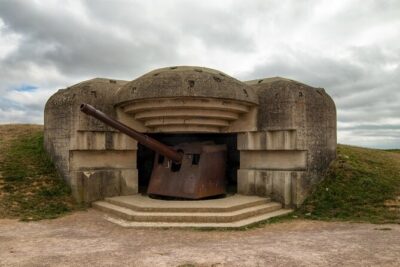
Normandy Battlefields Tour – American Sites (A3)
Read our review →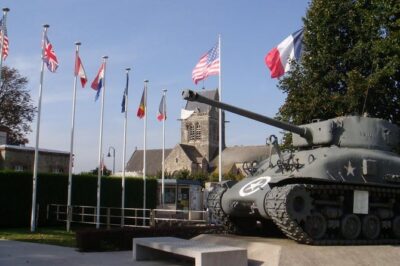
Browse the lists this tour appears in